
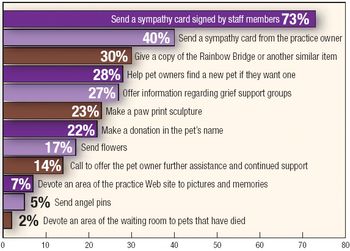
What steps does your practice team take to support clients after the euthanasia of a pet?
What steps does your practice team take to support clients after the euthanasia of a pet?

Inundated with signs, slogans, and sales pitches, pet owners may fail to notice a key message that you've posted right in front of them.

Do you put your best foot forward with every client, every time? These six tips can help make sure you do—and that you build the strongest possible relationships with clients.

At a recent staff meeting, I said I thought it was unprofessional for our medical and administrative support staff to chew gum on the job. I was almost laughed out of the meeting. Was I off base?
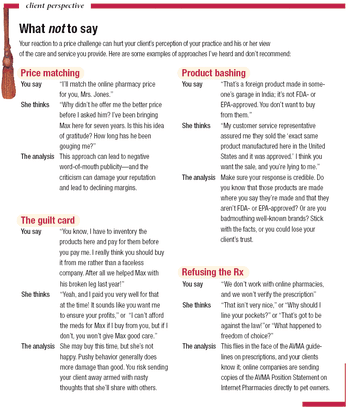
It was my job to sell pet owners on 1-800-PetMeds. But, the truth is, you're holding the best cards in this game. Just spotlight your strengths: service and value.

When a prospective client calls to ask how much I charge for a standard visit, my receptionist explains that my fees vary depending on the nature of the visit. I suspect this answer is driving away clients who are comparing fees as they search for a new veterinarian. Should my receptionist be more specific?
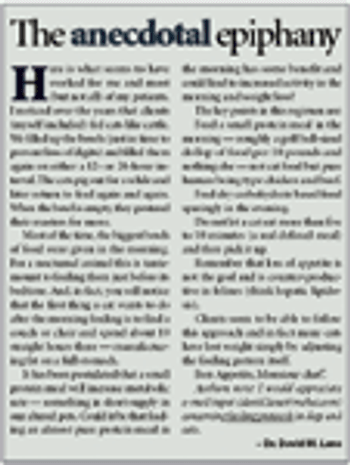
If an indoor cat has a low-protein, high-carbohydrate diet and nothing to do, the inevitable will ensue.
I read in a past issue about an equine practitioner who requires payment when services are rendered. I'd love to do that, but my clients expect me to bill them. How can I change my system this late in the game?

Even veterinarians sometimes overlook the power of the love and support pets provide. But now and then you may get an important reminder that a pet can lend hope and support healing—just as this veterinary student did.

A new client makes inappropriate comments to one of my employees. She asked him to stop, but he hasn't. Should I dismiss the client?
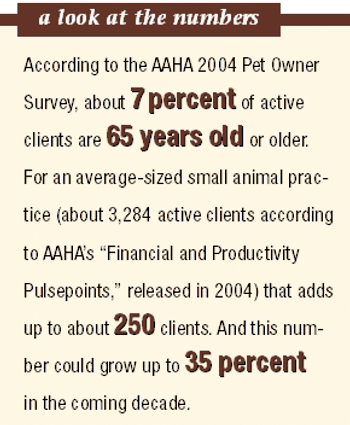
By 2010, almost 40 million Americans will be 65 years old or older. Are you prepared to meet the needs of these clients?
Acres Animal Hospital in Dartmouth, Nova Scotia, has found a way to help both the practice and its clients see green.

E-mails you send to clients to inform them of new offerings or to update them on practice happenings could be considered spam under the Controlling the Assault of Non-Solicited Pornography and Marketing Act (CAN-SPAM). To stay on the right side of the law, follow these guidelines, set forth in the CAN-SPAM Act, for commercial e-mails to existing and potential clients:

I own a feline-exclusive practice. Our prices are comparable to others in the area, except for our physical exam, which is $6 to $14 lower than most of my colleagues'. I've been thinking of raising it by $6 or $8, but several members of my team think our lower-priced office visit gets clients in the door. Once they're here, they rarely decline any additional recommended services. My team feels that without the enticing exam price, potential clients might be tempted to go elsewhere. What should I do?
You know the product or service you're recommending could help your patients. The problem is holding clients' attention long enough to explain the benefits.
With the advent of e-mail, it's easy to jot a disjointed note and send it off to clients or colleagues. But a slap-dash approach may lead you to say things you'd never consider appropriate if you were using a pen and paper. Keep out of trouble with these e-mail etiquette tips:
Think you're communicating--and selling--your services effectively? Here are some key points to consider to help you make powerful and persuasive recommendations to your clients
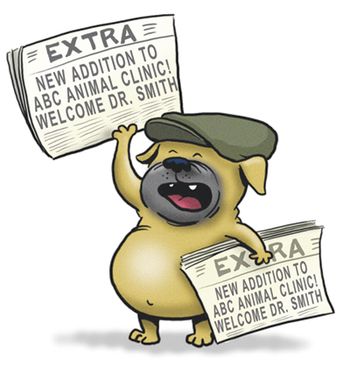
Welcome new associates to your practice with some functional fanfare that simultaneously introduces them to the public. Running an announcement ad in your local paper provides increased visibility for your practice and establishes the new associate as part of the community.
For years, veterinarians practiced reactively, primarily treating illnesses and administering vaccinations. Not anymore. According to the 2004 AAHA Pet Owner Survey, 94 percent of respondents take their pets to the veterinarian for regular checkups to ensure their quality of life. In fact, 58 percent of respondents visit their pet's doctor more often than they visit their physician.
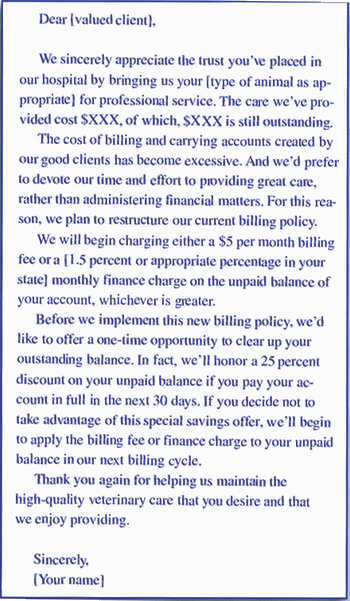
My office manager suggested that we discount hard-to-collect, 90-day-past-due accounts as an incentive to encourage patients to pay at least something. We'd offer up to 25 percent off the bill, depending on how much the patient pays. We'd require the patient to adhere to a payment schedule until the debt's paid off. Is this a good solution or does it contribute to the problem?

Is it legal to leave a message on a client's answering machine saying that you received a returned check? What's the best way to handle this situation?
Use this list of benefits to guide conversations with clients about spaying and neutering pets. (PDF)
This sample phone script shows the kind of professional, accurate answers you can develop for team members to use in all their interactions with clients. (PDF)

What does your receptionist say to a client who claims to have forgotten his or her checkbook? Or how does your technician respond to an angry client? In such cases, is everyone following a similar script? Is what they're saying the best response? If not, role-playing may help.
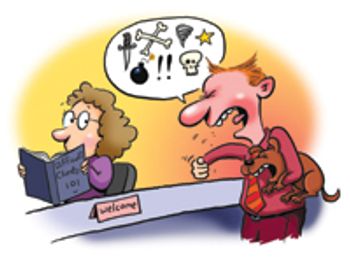
Your team members may find it takes some practice to stay calm and collected when unexpected situations arise. According to Ethics4Everyone, by Eric Harvey and Scott Airitam (Performance Systems Corp., 2002), it's best to prepare staff members for difficult events by playing the "what if" game.
A Pennsylvania veterinarian's public reprimand by the State Board of Veterinary Medicine was overturned by a Commonwealth Court panel, according to the Associated Press.
One hospital and its clients help a family stunned by tragedy pick up the pieces and begin a new life.

I tried to explain that six years and 60 pounds alters a lot of things. He was not in agreement.
What message does the appearance of your clinic send? And what message do the doctors, technicians, and support staff members send when they interact with clients? For a real eye opener, ask your clients these questions, using surveys, focus groups, and casual conversations during appointments. And don't forget to ask new clients and staff members why they chose your clinic. Their fresh eyes can offer valuable insights into the first impressions your practice makes.
Sure, Brownie's not as spry as she used to be," says your slightly indignant client, petting her basset hound's bowling ball stomach. "But that doesn't mean that she's not a healthy, happy dog, Doctor."