

Review this sample euthanasia protocol with your team to decide how you'll handle euthanasia procedures consistently and compassionately.
Review this sample euthanasia protocol with your team to decide how you'll handle euthanasia procedures consistently and compassionately.
What does your practice value? Read this sample practice principles card, then write your own standards of service to keep your values and creed top-of-mind when you're talking with clients.
Washington - 11/9/07 - With 70 percent of the Medical Reserve Corps units lacking veterinarians, the national network is looking for DVMs to join the local community ranks as volunteer physicians, nurses, pharmacists and dentists, among other professional health positions.

Is your practice easy to do business with? How can you achieve this goal? Here are some ideas.
In calming an irate client, remember your tone and goal. Keep your tone normal when talking to the client and your body relaxed. Always remember that your goal should be to listen to their needs and try to meet them when appropriate.
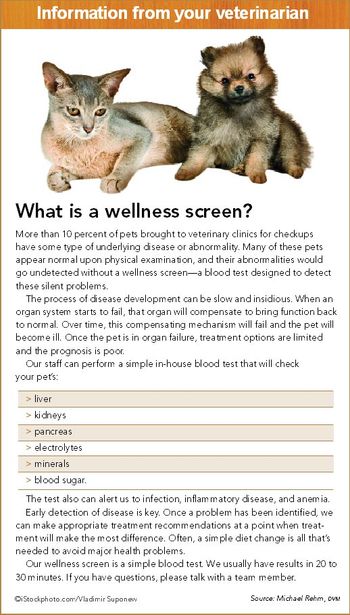
This preventive care program increases client bonding and extends pets' lives.
It's time to reconsider these myths and misconceptions about pricing.
It's easy to get fired--lying or stealing will l get you there fast. But if you want to take the slow, painful route, use these examples to really ruin your reputation before you get the heave-ho.
Q What's the best way to keep track of expiration dates on drugs?

Our mixed animal practice is co-owned by one part-time and one full-time veterinarian. The part-time doctor handles the administrative duties, but she regularly arrives late and leaves early. The result: Our practice doesn't function smoothly and we're constantly operating in crisis mode. What can our team do?
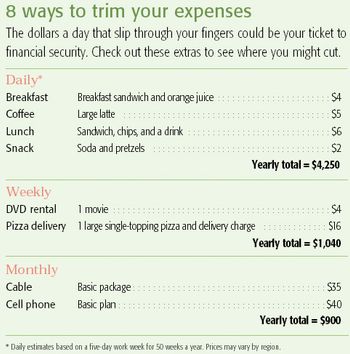
Maybe you can imagine happily working forever. But wouldn't it be nice if you didn't have to? Here's a growth formula to help your seed money blossom into a bouquet of retirement bucks.
Q. I'd like to get the name of my practice mentioned in the media. What's the best way to figure out who to contact in the local media?
You're the practice manager at a mid-sized clinic. When the stress index is high, one of the associates snaps at team members. Several team members have complained, and a few have threatened to quit. You're ready to discuss the problem with Dr. Sweet, the associate. Firstline Editorial Advisory Board member Pam Weakley offers this sample script:
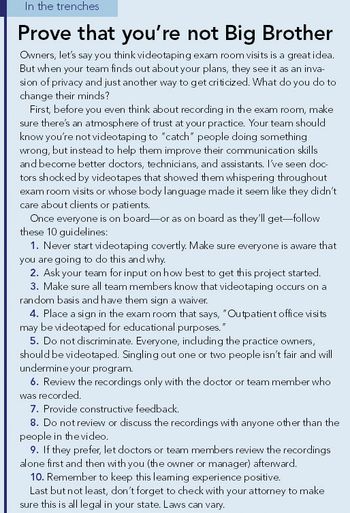
Videotaping in the exam room may make everyone nervous at first. But strong communication skills get clients on board with the best care. And this tool can help.
Use these forms to create a bulletin board that introduces your team members to clients.

Q How do I get team members interested in continuing education (CE)?
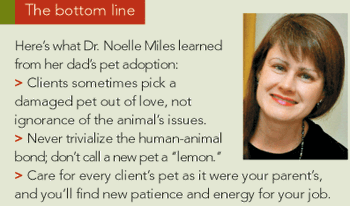
Probably not, but I learned better client care when my dad ignored my advice and picked a pet with his heart-not his head.

Owning a pet is a lifelong journey. Help set clients' direction by offering strong care recommendations on nine critical topics.
When you say you're a technician, most people probably ask, "What's that?" You can educate your clients--and co-workers--about the job you do with an educational bulletin board.

No, it's not the fees you're charging. The words you're using are doing the damage.
Tired of the usual performance rewards, Margaret Fasnacht, business manager at Animal Critical Care and Specialty Group in Malvern, Pa., decided to try a different approach. She presented reception team members with a unique gift certificate-good for one extra paid vacation day and Fasnacht's personal commitment to cover the shift on the team member's day off.
AVMA data shows 56,092 practicing veterinarians in the United States at 27,123 practices. That's about two doctors in each practice. And in two-doctor companion animal practices, the National Commission on Veterinary Economic Issues (NCVEI) reports a staff-to-doctor ratio of 2.99. That's six team members and two doctors in the average companion animal practice.
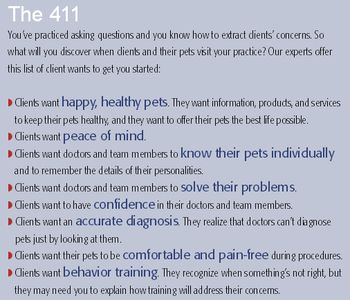
Unfortunately, you can't read clients' minds and predict the information, products, and services they want. But you can take a good guess through a revolutionary process called listening.

You can probably look down the street and see someone you know doing a job similar to the one you do every day. The only difference: The patients at your practice are pets, and theirs are people.
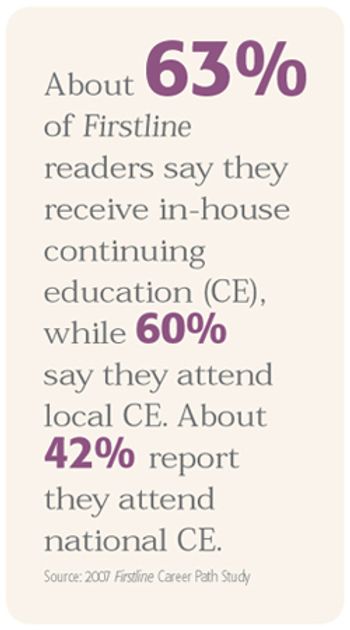
Seventy percent of Firstline readers say they need in-house training to take the next step in their career, according to the 2007 Firstline Career Path Study. And about 68 percent say they also require formal training to grow in their jobs.
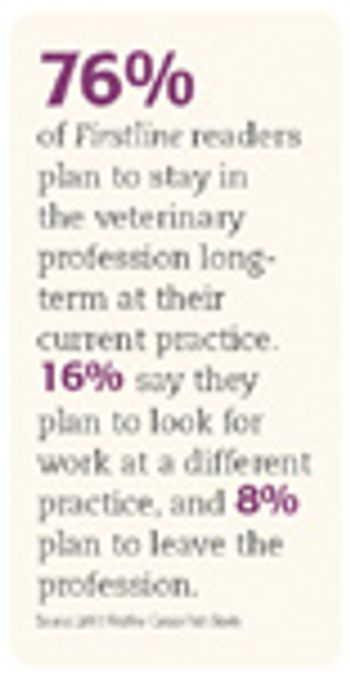
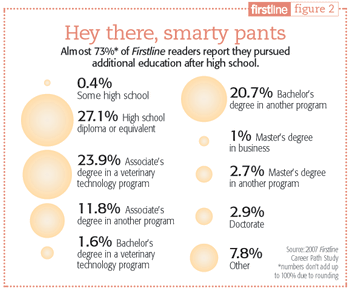
What's the difference between a job and a career, and which would you use to describe the work you do? While some team members deliberately take the veterinary path, others just stumble across it by accident. Regardless of how or why, let's see what the label you've chosen means.
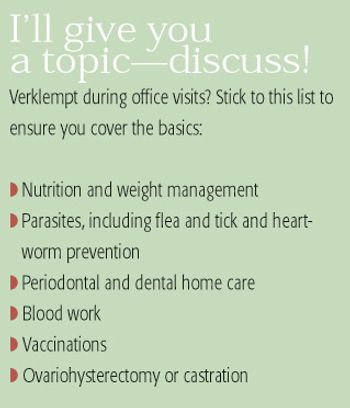
Are you informal about informing, easygoing about educating, casual about coaching clients about their animals? See how more structure benefits your practice, pet owners, and patients.
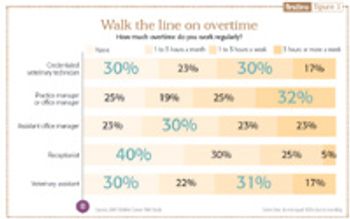
Yes, but it takes practice. Firstline readers who are 46 to 55 years old are most likely to work more than three hours of overtime, while those who are 56 or older report they're most likely to work no overtime.
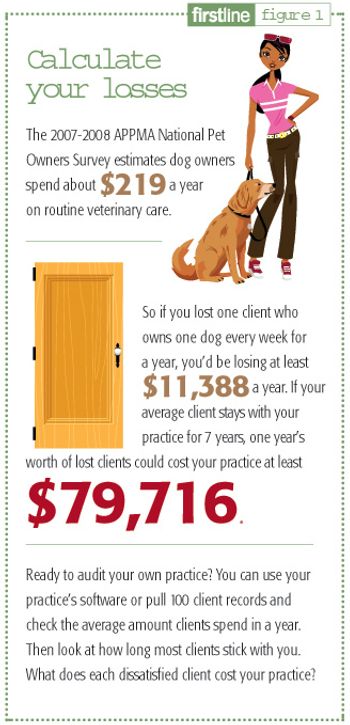
It's probably more than you think. For example, a typical dog owner spends $219 a year on routine veterinary care, while a cat owner spends $175, according to the 2007-2008 APPMA National Pet Owners Survey (see Figure 1).
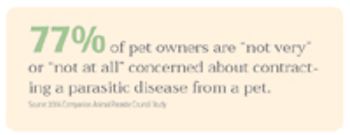
Yes. But oddly enough, few pet owners take the right steps to protect their pets, their families, and themselves from infestations (see Figure 1)