

Don't waste your energy trying to squeeze a 15,000-square-foot hospital onto a 3,000-square-foot lot. Instead, exercise flexible thinking, creative planning, and strategic cost controls to build your dream.
Don't waste your energy trying to squeeze a 15,000-square-foot hospital onto a 3,000-square-foot lot. Instead, exercise flexible thinking, creative planning, and strategic cost controls to build your dream.

My office manager wants to join a professional association and asked if I'd pay the annual dues. Should I? Should I do the same for other employees? Are the dues deductible?

I own a small practice, and 2 percent to 4 percent of the gross won't support a manager. So how can I get the necessary help for such issues as personnel, financial, and facilities management?
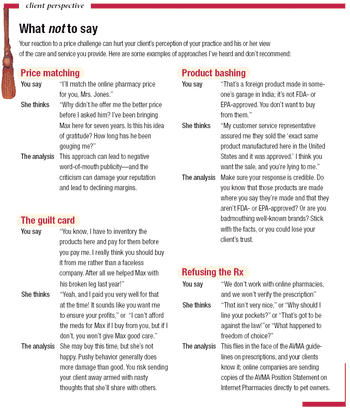
It was my job to sell pet owners on 1-800-PetMeds. But, the truth is, you're holding the best cards in this game. Just spotlight your strengths: service and value.
When a prospective client calls to ask how much I charge for a standard visit, my receptionist explains that my fees vary depending on the nature of the visit. I suspect this answer is driving away clients who are comparing fees as they search for a new veterinarian. Should my receptionist be more specific?

I will be receiving a retirement plan distribution when I change jobs. I intend to roll it over to my new employer's plan and have been told that such a rollover will avoid a 20 percent withholding tax.

Show off your new building or renovation by hosting an open house.

There's more to a good site than the right location. Here's a look at the other factors you need to consider.
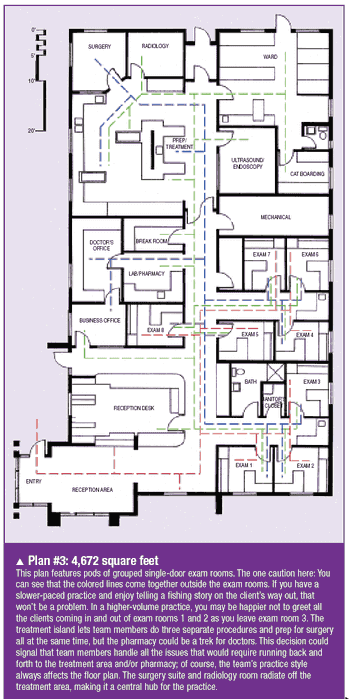
Learn from these examples and avoid traffic snarls in your new practice.

Learn how to build a winning hospital from start to finish with this advice from Veterinary Economics Editorial Advisory Board members and Hospital Design Competition winners.
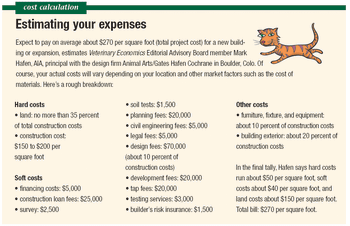
Your banker wants to know whether you're a good risk-and you want to know you're getting a reasonable deal. Use these tips to balance the equation.
I read in a past issue about an equine practitioner who requires payment when services are rendered. I'd love to do that, but my clients expect me to bill them. How can I change my system this late in the game?

The day you become an owner is the day you should start planning to sell. Here's why-and a look at what to consider.
I own a feline-exclusive practice. Our prices are comparable to others in the area, except for our physical exam, which is $6 to $14 lower than most of my colleagues'. I've been thinking of raising it by $6 or $8, but several members of my team think our lower-priced office visit gets clients in the door. Once they're here, they rarely decline any additional recommended services. My team feels that without the enticing exam price, potential clients might be tempted to go elsewhere. What should I do?

Is it possible for a start-up to be profitable from the beginning? If so, how?
Suddenly, in the midst of attempts to grow your practice, you find your cash flow dried up. And let's say your bank, no matter what you do, can't help you. What else can you do?

Long-range strategic planning requires making hard decisions in your practice. First, you must decide what you and your team are going to do more of. What's working? What services, activities, and products generate the most practice growth and are the most profitable? For example, are pre-anesthetic risk assessments profitable—and good medicine? If so, you may want to challenge your team to increase clients' acceptance of such procedures.
Three-quarters of people still paying off their student loans say the payments are large enough to keep them from buying a car or a house, says the Cambridge Consumer Credit Index.
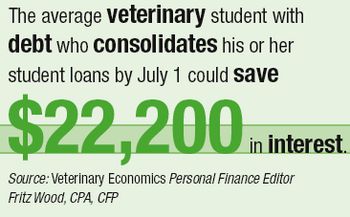
Student loan rates are at historic lows, says Veterinary Economics Personal Finance Editor Fritz Wood, CPA, CFP, but not for long. Wood says recent and soon-to-be graduates should act now to consolidate their student loans.
Dr. Brad Rosonke, owner of Hillside Animal Hospital in Scottsdale, Ariz., has little interest in dentistry. But he knows that offering dental services means better care for his patients. His solution: Hire a dental resident--in his case, Dr. Peter Bates--to visit his practice on a regular basis. "This is a win-win-win situation," says Dr. Rosonke. "Dr. Bates needs to see more patients during his residency, I'm now free to see other patients while he's taking care of dental issues, and our clients get more complete care for their pets."

A growing business adds customers, expands inventory, buys equipment, and hires new staff. The future looks great on paper, but the additional expenses bring a cash crunch, particularly if collections are slow.
Think you know where your personal finances stand? If you're married, your spouse likely sees family earnings and expenses differently.
I'm about to sell my practice. Is there any reason why I can't do the appraisal myself?
In addition to arrhythmias, valvular insufficiency as detected by the auscultation of a murmur may result in signs of exercise intolerance.
I have lost count of the number of occasions when I have written in this column that partnership in a veterinary practice is very similar to marriage. The analogy is one that potential partners must ignore at their peril. Nonetheless, joint ownership of a professional practice can be much like something else as well: a couple moving in together.
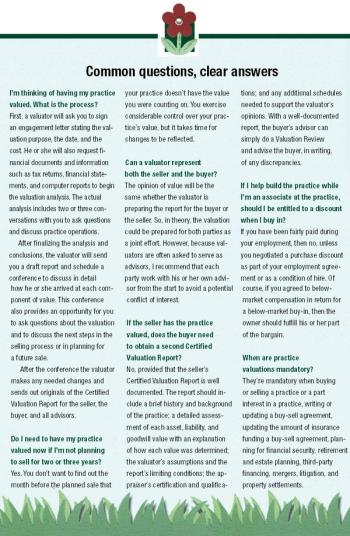
A potential buyer will want to know what it would cost to provide the same services you offer.

Not all tax deductions are created equal. When it comes to building projects, the normal write-off for building costs is 39 years. However, with a little homework and the help of a builder and architect, you can accelerate deductions. The concept at work: cost segregation.
Neel Veterinary Hospital in Oklahoma City, a paperless practice that purchased its first computer and electronic medical record system in 1993, prides itself on its commitment to using the latest technology. ?Adding computer radiography was a natural step in the evolution of our practice,? says co-owner Dr. Tina Neel.
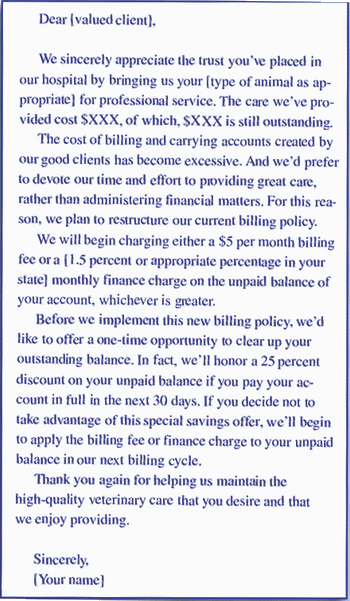
My office manager suggested that we discount hard-to-collect, 90-day-past-due accounts as an incentive to encourage patients to pay at least something. We'd offer up to 25 percent off the bill, depending on how much the patient pays. We'd require the patient to adhere to a payment schedule until the debt's paid off. Is this a good solution or does it contribute to the problem?
Expect health insurance to cost about 10 percent more this year, marking five years of double-digit increases, according to The Washington Post.