

Raising fees isn't the only way to fuel revenue growth. Use these strategies to customize your revenue plan.
Raising fees isn't the only way to fuel revenue growth. Use these strategies to customize your revenue plan.

Practitioners charge too little because they cannot keep up with the literature.
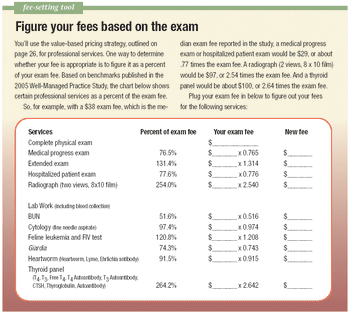
Do you feel like you're always batting at your fees without ever pinning down the perfect fee schedule? Use this advice to align your fees with the level of client service and animal care you provide.

I perform services at a discount for a local nonprofit group. Can I write off the discounts?
Lynette Ott, the practice manager at Barton Heights Veterinary Hospital in Stroudsburg, Pa., always heard that 20 percent of clients bring in 80 percent of income. Not content to blindly adopt the mantra, Ott went looking for data.

If missed charges are slipping out the door, you may be seeing a smaller paycheck and fewer benefits—and you may find it harder to offer high-quality care.
What percent of practice revenue should go to food and products?

What's the expected average increase in gross income in the year after opening a practice?

How do you determine expected yearly production for veterinarians? How should it change based on years of experience?

I'm a full-time veterinarian, and my employer pays for my health insurance, which costs about $4,000 a year. I recently got married, and my husband's insurance is better. If I join my husband's policy, should I get that $4,000 benefit somewhere else in my package? Is it fair to ask my boss to add it to my salary or to add more paid vacation days in equivalent to the benefit money?

Q. I'm an associate veterinarian paid on a straight salary. My employer doesn't offer group health insurance as part of my contract, but I'd like him to pay my medical insurance premiums and those of my husband and son. I checked with the IRS, and it appears that he can pay the premiums for my family tax-free. If he offers me this benefit, does he have to offer it to everyone on salary?
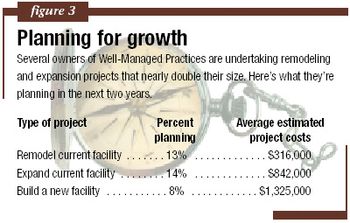
The 2005 Well-Managed Practice Study shows how important strategic planning is to achieving your practice vision-and respondents say their only regrets are not planning sooner.

Being in your own business is working 80 hours a week so that you can avoid working 40 hours a week for someone else.
Well-managed practices realize they need to reinvest to keep their practices moving forward. Here's how they plan to leverage their facilities.
For 12 years, Dr. Steve Bishop and his crew at Animal Care Hospital in Phoenix have been tapping the retired population to make callbacks in the early evening. Doing so frees time for receptionists to work on other jobs, he says. "Plus, the hourly pay is less than for a receptionist, and the workers are more flexible with their time."
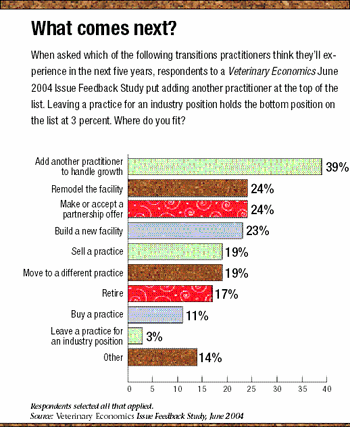
Taking the next big step in practice? Whether you're adding a doctor to the team, making the jump to partner, or taking on a remodeling or building project, we've got the right advice.

Your colleagues use these programs to improve care and raise revenue. Would a similar approach work for you?
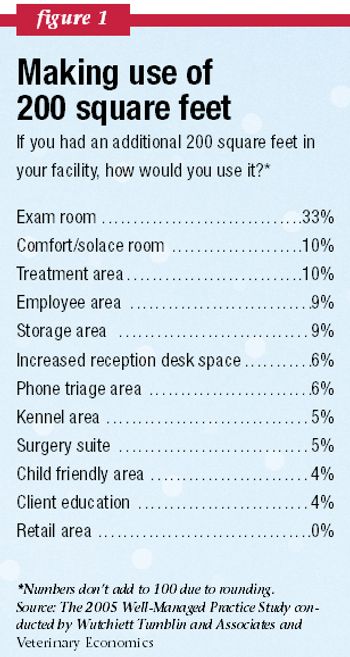
Are you making the most of your practice space? Find out by breaking down your earnings by square foot and comparing your numbers with these averages for each profit center.
A good negotiator earns up to $31,000 more a year. But pay heed; bad negotiations can cost you big. Are you letting too much money trot off?
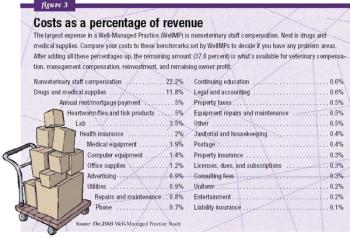
Health insurance and drugs and medical supplies munch down the most cash. But they aren't the only expenses nibbling at your funds.
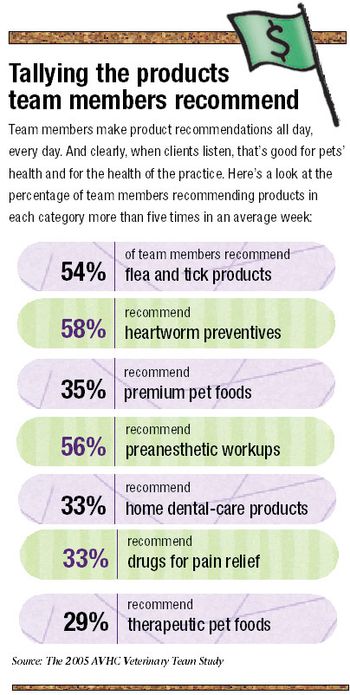
Use these strategies to harness your team members' power to drive client compliance and revenue—and improve your patients' health.

Choosing to ignore monthly financial reports could cost you as much as $42,000 per year. Are you willing to give that money away?

My partner and I recently learned that we're paying associates more than other practitioners in our area do. How should we get our compensation more in line with prevailing wages-with a salary freeze or a pay cut?
According to Gallup's annual Personal Finance poll, American's top financial worry is retirement.
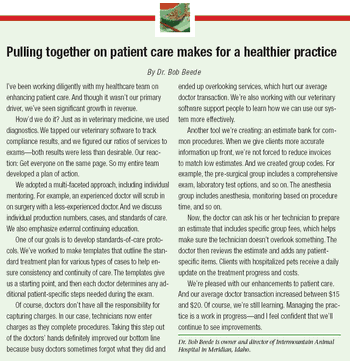
Find out-and crack down on missed charges using these strategies. Remember: Focused attention on this issue brings prosperity and job satisfaction to your future.

Even small businesses create hundreds of transactions during a month. And when you add your personal banking to the mix, it's easy to become overwhelmed, especially if you don't like bookkeeping.
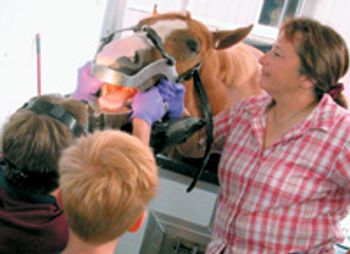
Does every horse that you see undergo a dental exam? Is a complete oral exam including the use of sedation, a full-mouth speculum, a good headlight and a dental mirror part of your yearly preventative maintenance program? Do you include a complete oral exam as a part of all your pre-purchase exams? If you answered "Yes" to these questions, then you are, unfortunately, in the minority of equine practitioners today.
High overtime costs prompted Gerard Gervasi, hospital administrator at Collierville Animal Clinic in Collierville, Tenn., and the practice owners to look into the financial impact of being open on Saturdays--and find a new solution.
Low costs aren't the only reason to choose a lender. Also consider these important details before saying yes.

These doctors learned the hard way what they should have done during the construction of their hospitals. Now that they're enjoying their award-winning facilities, they're ready to share their stories—and help you avoid the same problems.