

A new San Francisco law passed by the Board of Supervisors says that backyard dogs deserve a daily change of water; edible and nutritious food; nontipping bowls; and a dog house with a roof, floor, and three sides.
A new San Francisco law passed by the Board of Supervisors says that backyard dogs deserve a daily change of water; edible and nutritious food; nontipping bowls; and a dog house with a roof, floor, and three sides.

I've played hockey for many years, often once or twice a week. One day it dawned on me I wasn't improving. Instead I was doing the same wrong things over and over--I was playing but not practicing. Finally, I took a skills class and was amazed at how much I didn't know.
At our practice, we have an inventory team that handles ordering and tracking of drugs, lab supplies, food, and so on. But we still struggle with inventory accuracy. Would establishing an incentive program for the inventory team help?

Dr. Ron Linkenheil, owner of the Corning Animal Hospital, in Corning, N.Y., brightens up staff members' Mondays with a special snack, which helps jump-start the week.
The U.S. Supreme Court has yet to decide whether the mandatory fee on cattle sold in the United States is legal. Half of the money goes to the National Cattlemen's Beef Association (NCBA) and half to state beef councils to help fund advertising, research, and education programs.
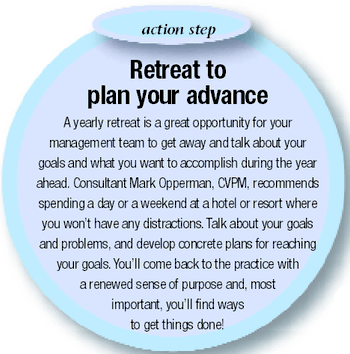
In prior articles, I gave advice on creating and writing a strong, compelling vision for your life and work. But crafting the vision is just the first step. Next you must figure out how to make your vision a reality.
Work better with goal planning.
This goal planning form helps you think through the steps you'll take to achieve your objective and spot potential obstacles. (PDF)
Different people find different situations stressful, but some stressors transcend personal differences and affect a majority. Many such key job stresses are associated with these six categories:
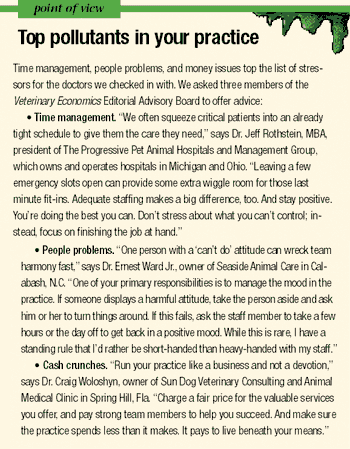
Use these strategies to make sure tension never becomes toxic for you or your team.

Effective delegation is undoubtedly the strongest productivity-improvement tool available. But here's a harsh reality check: Only 47 percent of staff members responding to a VetMedTeam survey indicated that their doctors delegate 80 percent to 100 percent of possible tasks.

Let's solve your morale problem by just firing all the unhappy people. Think that sounds rash? The truth is you have nothing to gain from keeping them around. You can't change them. Yes, you can require certain behaviors, such as being on time, doing their jobs, or developing proficient skills or knowledge. But a lot of people simply have a rotten, negative attitude, and there isn't much you or anyone else can do to change that.
Exit interviews are your best tool for learning why employees leave and how you might encourage them to stay. Use this form to gather this precious feedback from departing team members. (PDF)
Use this list of benefits to guide conversations with clients about spaying and neutering pets. (PDF)
This sample phone script shows the kind of professional, accurate answers you can develop for team members to use in all their interactions with clients. (PDF)
When you conduct regular performance reviews, you build better understanding with your employees, clarify your mutual goals, and give employees feedback about where they excel and could improve. Use this form to get started. (PDF)
You and your staff members likely make tough ethical decisions every day. Yet only 43 percent of respondents to a recent survey by VetMedTeam.com, an online resource and team training center, say their practice teams discuss ethics.

Colby Nolan, MBA, worked with a Pennsylvania prosecutor to catch two Internet spammers who were selling bogus college degrees. All Nolan had to do was receive his masters in business administration from Trinity Southern University.

An old dust-covered law that banned dog and cat cohabitation was recently lifted in Provo, Utah.

What does your receptionist say to a client who claims to have forgotten his or her checkbook? Or how does your technician respond to an angry client? In such cases, is everyone following a similar script? Is what they're saying the best response? If not, role-playing may help.
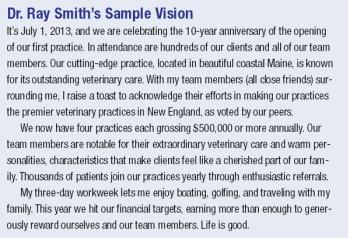
Last month, we discussed the power of crafting a compelling practice vision. The next step: putting your vision in writing. As you're writing, see your vision as an already-accomplished reality, not merely as something you hope will happen. Write in the first person and present tense, creating a vivid mental image with as much detail as possible to bring your vision to life. Use all your senses—sight, hearing, touch, smell, and taste—to develop your description.
Let staff members know how much you appreciate all they do by adding a personal touch to their paycheck stubs, suggests Dr. Laura Lee at Acres Animal Hospital in Dartmouth, Nova Scotia.
A woman was charged with maiming and mutilating animals after performing two cat operations in her home.

I recently appeared as an expert witness for an abuse and neglect case. The defense attorney subpoenaed me, but I was more helpful for the prosecution. I'd like to bill the defense attorney for my time; however, I anticipate that he won't readily pay. Should I take the attorney to small claims court?

It's 7 a.m. on a Tuesday morning, and our house is in its usual state of controlled chaos. Breakfast bowls are clinking, backpacks are zipping, and comments are flying around the kitchen faster than a budgie on a beak-trim breakaway. Unfortunately, every sentence seems to start with my name.

You're enjoying practice, and your clients and team members are happy. But don't let complacency take hold. These common pitfalls can bump you off track.

A client sent us a thank-you card for our prompt, undivided attention and praised our team members for their kindness and courtesy. I'd like to post the note on the bulletin board in the reception area. Assuming the client gives permission, is there a downside?
A Pennsylvania veterinarian's public reprimand by the State Board of Veterinary Medicine was overturned by a Commonwealth Court panel, according to the Associated Press.
Buying into a practice could bring great opportunities or heartache. The key: Know what you're getting into.
I want to hire a veterinarian who's board-certified in internal medicine. How should I compensate this person? Should I pay based on production or a split rate, or should I rent space to the practitioner? If I pay based on production, would the percent be different than with a non-board-certified veterinarian?