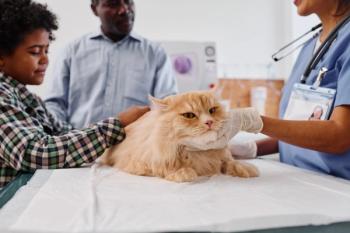
The World Health Organization records some 400,000 cat bites to people in the US annually,2 a figure thought to reflect gross underreporting. For dog bites, the number is 10 times higher.
At the vet office, assaults on human kin are often a friendly fire, knee-jerk response to triggers such as needle sticks, noises, smells, strangers…or even to their owners. “Many people have anxiety when they come in, and their pets feel that anxiety,” Amy Kidd, VMD, owner of Pocopson Veterinary Station in West Chester, Pennsylvania, said.
But home and site visits are not jeopardy-free either, with clients more likely to restrain or otherwise handle patients in equine, food animal, and mobile practices.
Overall, trends belie the “he would never bite me” hum we hear from pet parents: In one study, almost half of the reported cat-to-human bites were inflicted by one’s own cat.3 Furthermore, some 46% of cat bites and scratches land on the hands and wrists.3
Animal-related human injuries can lead to serious infection.2,4 Cat bites to the hand are so dangerous, according to a Mayo Clinic study, that 1 in 3 patients with such wounds had to be hospitalized; most of these needed surgery.4
Who’s to blame?
In Bowers’ experience, most folks are reluctant to blame clinic staff when their pet wounds them. However, the hospital still may be held financially responsible for medical care and losses, and the incident would fall under the practice’s professional liability coverage.
The issue of negligence can be thorny, explained attorney April S. Goodwin, JD, of The Goodwin Firm in St. Petersburg, Florida. Who was in the room when the incident occurred? Should the veterinarian or technician have known the animal might become combative? Were attempts made to muzzle or sedate the pet? Was the owner asked to restrain it?
Goodwin said written guidelines offer rock-solid support. “It’s a good practice to have a policy posted in the clinic where everyone can see it, so the vets and vet techs have backup in enforcing it,” Goodwin said. “When an owner says, ‘Can I hold my dog?,’ staff can then say, ‘I would love to let you, but the policy says no.’”
Protecting owners from pets
To keep pet parents and patients safe during veterinary appointments, consider the following risk-management recommendations:
- Use preappointment screening data and patient alerts to help staff anticipate behavior.
- Dispense previsit medications for calming, and sedate when necessary.
- Allow only trained, experienced staff—not clients—to hold patients during exams and procedures.
- Post signage outlining this safety policy.
- Utilize appropriate restraint tools, such as muzzles, bite-resistant gloves, cat bags, and towels.
- Minimize triggering stimuli, such as smells, loud noises, and quick movements.
- Be aware of where clients (and their children) are during treatment, and ensure they remain at a safe distance from potentially reactive pets.
- Bring fractious animals into back treatment areas if they cannot be maintained safely near their owners.
Finally, modify the above protocol as needed for a given patient. Kidd recalls a Great Dane she was treating during the COVID-19 pandemic, when owners had to remain outside the building. When they brought the dog inside, he tried to jump back out through a screen. So she let the owner come inside. Once he sat beside the dog, calmness returned. “With the owner right there, we were able to do anything and everything to the dog with no problems,” Kidd said.
References
- Professional Liability. AVMA Trust. 2024. https://www.avmaplit.com/education/
- Fact sheets: animal bites. World Health Organization. January 12, 2024. Accessed March 4, 2026. http://who.int/news-room/fact-sheets/detail/animal-bites
- Chen Y, Gao Y, Zhou L, Tan Y, Li L. A comparative study of dog- and cat-induced injury on incidence and risk factors among children. Int J Environ Res Public Health. 2016;13(11):1079. doi:10.3390/ijerph13111079
- Babovic N, Cayci C, Carlsen BT. Cat bite infections of the hand: assessment of morbidity and predictors of severe infection. J Hand Surg Am. 2014;39(2):286-290. doi:10.1016/j.jhsa.2013.11.003