


News|Videos|October 23, 2026
dvm360 Live! digs into complex wound cases

Steve Mehler, DVM, DACVS, shares his approach to open wound management and walks host Adam Christman, DVM, MBA through 3 memorable cases.
Advertisement
Content sponsored by NovaQuis Animal Health.
Episodes in this series



Editor’s note: Some of the following images are graphic in nature and might be disturbing to some viewers.
Wound management can test a veterinary team's patience and creativity, especially when the visible injury is only part of the story. In the season 3 premiere of dvm360 Live!, host Adam Christman, DVM, MBA, chief veterinary officer of dvm360, welcomed board-certified veterinary surgeon Steve Mehler, DVM, DACVS, to discuss a newer approach to open wound care and review some of the toughest wounds of his career.
Mehler, who has trained veterinarians on 6 continents, emphasized that successful healing depends on the entire care team, pet owners included. "Chronic wound management is like any chronic disease. Without the pet parent and their compliance at home, it can be a disaster," he said. "You can do everything perfect in the clinic, and then at home, that can all be erased immediately."
Giving the wound bed structure
Mehler described ScafiGen Advanced Structural Hydrogel, which pairs the moisture of a hydrogel with a cohesive 3-dimensional scaffold designed to stabilize the wound bed and support mature granulation tissue formation. That tissue is a key milestone in open wound management, he explained. "Once you've got a nice granulation bed there, we have a wound that is now inherently resistant to infection. It's hard to screw that up afterwards," said Mehler.
Conventional hydrogels can fall short, he noted, because "sometimes you have these deep pocketing wounds, and a lot of the hydrogel products they really lack the residency to stay in place."
The product can be applied directly from the bottle or with a gloved finger, cotton swab, or gauze. A film of 1 mm or less is sufficient for surface wounds, whereas deeper pocketing wounds should be filled "right up to the wound edge," Mehler said. It can be used with or without a bandage, including on incisions.
Mehler cited a 473% return on investment for practices and highlighted the take-home bottles that let owners participate in care. Having owners apply the product at home "really gives them skin in the game," he said.
Advertisement
Related to this article

Steve Mehler, DVM, DACVS, discusses why cranial cruciate ligament disease is a chronic inflammatory condition and what that means for treatment.

Steve Mehler, DVM, DACVS, joins Adam Christman, DVM, MBA, on dvm360 Live! to explain how ScafiGen works, how to apply it, and how it can support wound care at home.

An elk harvested on a Texas game ranch marks the first wildlife case of the parasite in the US, prompting expanded surveillance and a call for hunters and wildlife professionals to report suspicious wounds.
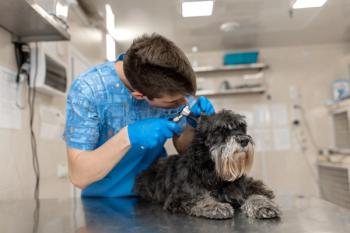
Technicians say they're ready to take on more clinical work. Pet owners say they're open to booking visits with them.

La medicina veterinaria suele medirse según el gold standard. Pero, como en el podio olímpico, la plata y el bronce también cuentan, sobre todo cuando el oro está fuera del alcance económico del cliente.

The same survey found that owners with the strongest bonds to their pets were more likely to visit the veterinarian regularly and keep up with vaccinations.

When December feels like a grind, a waterfront venue, 60-degree weather, and a top-tier education lineup may be just what your team needs to recharge.

Medications shipped nationwide from February through early October may contain too little or too much active drug. The company has reported 98 complaints to date—7 of them serious.
Advertisement
Advertisement
Trending on dvm360
1
Wedgewood recalls nearly 4000 compounded veterinary products over drug potency concerns
2
USDA confirms first New World screwworm detection in US wildlife
3
An untapped clinical resource may already be on staff, research suggests
4
Health benefits of pet ownership are widely felt and recognized, HABRI survey finds.
5