
















If the foal is less than 12 hours, it can be given 1-3 liters of high quality (sp gr > 1.090) colostrum. (Frozen colostrum should be thawed in warm water, rather than the microwave. Ideally colostrum should be < 12 months old).

If the foal is less than 12 hours, it can be given 1-3 liters of high quality (sp gr > 1.090) colostrum. (Frozen colostrum should be thawed in warm water, rather than the microwave. Ideally colostrum should be < 12 months old).

Equine colitis can be a diagnostic and therapeutic challenge for both practitioners and owners alike. The presenting clinical signs can be identical regardless of the etiology.

Strangles is a result of bacterial infection with Streptococcus equi subspecies equi (referred to as S. equi). The disease has been in the equine population for centuries and was first reported in 1251 (Sweeney et al, 2005i). The infection is highly contagious in horse populations and can become endemic on farms with previous outbreaks of the disease.

Recurrent airway obstruction (also known as heaves, chronic bronchitis, chronic obstructive pulmonary disease, broken wind, and chronic airway reactivity) is a common respiratory disease of horses characterized by periods of reversible airway obstruction caused by neutrophil accumulation, mucus production, and bronchospasm.

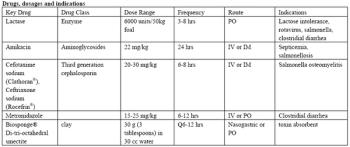
Diarrhea is a significant cause of morbidity and mortality in foals. Numerous noninfectious and infectious agents are responsible for enterocolitis and enteritis in the newborn foal.

Unlike EGUS, colonic ulcers and the condition Right Dorsal Colitis (RDC) occur less frequently, but may lead to hypoproteinemia and more severe clinical signs. In a necroscopic study of 545 horses, 44% of non-performance horses and 65% of the performance horses had colonic ulcers.

Veterinarians are often asked to induce parturition or they may recommend induction based on the mare's foaling history or the presence of medical conditions that threaten her health and well being. The need to induce a mare, and the chances of foal survival should be based on objective measures.

Equine protozoal myeloencephalitis (EPM) is a common neurological disease of horses in the Americas. Horses with EPM most commonly have abnormalities of gait but also may present with signs of brain disease.

As the weather heats up, so does the incidence of heat exhaustion and heat stroke in horses.

Targeted horse husbandry and evolution has produced an elite equine athlete capable of attaining fast speeds and exercising over long distances.

What should practitioners consider when evaluating and recommending nutritional supplements for equine patients?

National Report -- An outbreak of equine herpesvirus (EHV-1) that raced through 12 Western states in late spring has officially come to an end.

Saskatoon, Canada -- The University Saskatchewan's large-animal veterinary hospital just closed its doors to non-emergency equine patients after a new equine herpesvirus (EHV-1) case surfaced in the area.

Dr. Jim Guenther offers guidelines for discussing equine herpesvirus with clients.

National Report -- While veterinary officials say the equine herpes virus (EHV-1) outbreak from a Utah cutting horse competition is on the decline, Montana confirmed its first primary case in a quarantined horse.

National Report -- Reports of new equine herpesvirus (EHV-1) cases originating from a Utah cutting horse event are slowing, veterinarians report, but new cases from secondary exposures remain a top concern.

John Cheetham, VetMB, Dipl. ACVS, Department of Clinical Sciences, Cornell University College of Veterinary Medicine, has recently received a grant from the Grayson-Jockey Club Research Foundation to study recurrent laryngeal neuropathy in horses.

Puncture wounds of the sole in horses can range from simple to complex-even life-threatening-depending on the area of penetration.

Little Rock, Ark. - Horseshoeing, training, the selling of equine medications and certain equine reproductive procedures are no longer a part of the veterinary practice act in Arkansas.

Radiation was first used on horses in 1906. Today, finer, more sophisticated therapeutic techniques, procedures and equipment can be used to treat the relatively uncommon tumors in horses.

Outbreaks of equine viral arteritis can be devastating to the equine industry.

Mobile practitioners, follow these tips to handle horse-health conversations on the go.

Secondary exposures now make up about half of all confirmed equine herpes virus cases.

Which joint is most affected by this foal's flexural deformity?

National Report -- Equine herpes virus (EHV-1) has now been confirmed in 44 horses in nine Western states following a national cutting horse event in Ogden, Utah.