


























Your veterinary clients likely won't volunteer that they're seeing signs of this disease in their senior pets, so make sure you're asking and educating with this social media campaign.
Your veterinary clients likely won't volunteer that they're seeing signs of this disease in their senior pets, so make sure you're asking and educating with this social media campaign.

Essentially we're asking about nature vs. nurture. Get a veterinary behaviorist's point of view on this eternal question.

Many of your older canine and feline veterinary patients are likely showing signs of cognitive decline. Have you been checking up on this treatable condition?

Use this handout to show clients this should not be the first training method of choice.
Switching styles can trip up the team, but the transition is worth the trouble.

Veterinary behavior expert Dr. Elise Christensen has seen many clients inadvertently set their pets up for failure when it comes to housetraining.
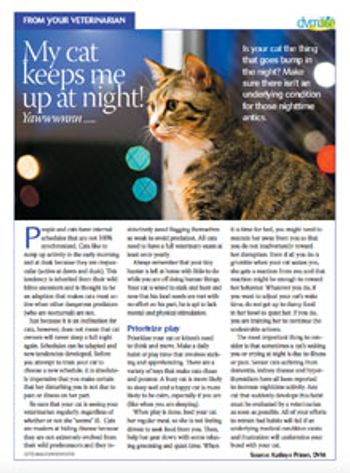
Don't let your cat owners suffer with no sleep because the cat causes a ruckus at night. Use these tips!
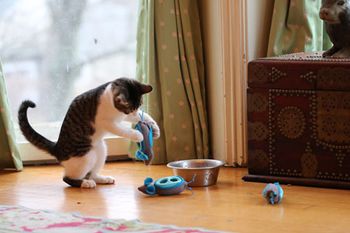
An innovative new feeding system for cats turns mealtime into hunting season.
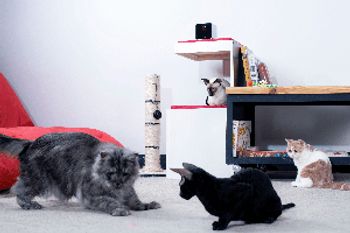
Pet cams like the Petcube Camera are spilling onto the pet retail market, giving pet owners a chance to see and even interact with their cats, dogs and whatever away from home. So ... silly gimmick or future tool for diagnosing at-home behavior problems? You decide.

"Just get it done" doesn't pay off in the long run. Instead, slow down and reduce the potential for pets' fears.
Our visits are action-packed, and our clients are time-strapped. But at our veterinary hospital, DVMs and technicians make sure we don't miss some crucial questions about home life and history for our patients.

Help your veterinary clients understand the motivation behind this normal behavior in dogs and how to fix it.
You can see happier, calmer pets in the exam room. Get a sneak peek on "how" here.

ELise Christensen, DVM, DACVB, offers solutions to help clients and keep cats in the home.
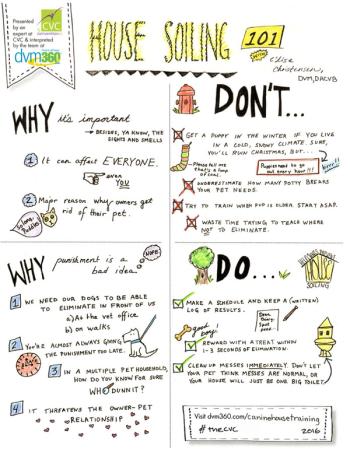
Why you should care about this veterinary behavior problemand how you can help pet owners.
Pet owners will vote with their moneyand do to veterinarians who understand behavior.
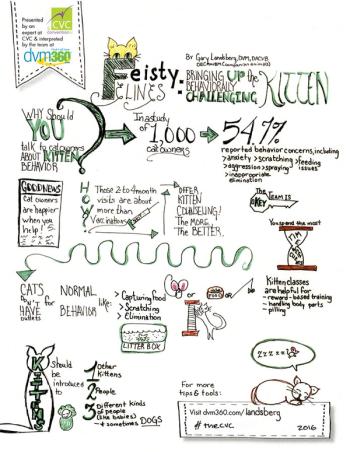
Here's a quick look at why you should talk to cat owners about kitten behavior.
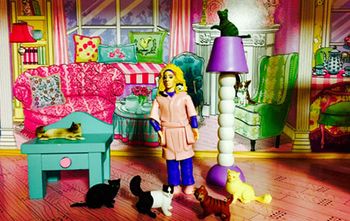
Help more kitties get the healthcare they need with this checklist to make it easier to get kitties to your practice.
You know your efforts benefit the patients in your veterinary practice-but the effect on pet owners is important too.
Your veterinary patients have several responses to extreme stress, but no matter which way they respond, their health may be in danger.
This handy abbreviation will help you pinpoint true cases of cognitive dysfunction in your veterinary patients.

Without cold, hard lab numbers and clear scientific proof, diagnosing neurologic conditions in your veterinary patients can be tough to describe, and without owner buy-in, they can be tough to treat. However, a recent review provides a starting point for providing clients with objective evidence.
Crash! Bang!! Boom!!! We all startle at loud noises, but do your clients know if loud or sudden noises are seriously affecting their dog's quality of life?

Successful behavior modification requires more than one ingredient. In this audio clip from CVC, behavior expert Melissa Spooner discusses how Composure, a nutritional supplement and behavior modification soup ingredient, can be used in your veterinary practice.

Familiarize yourself with this frightening condition in dogs and how you can best identify and overcome it.