

Try these strategies to beat back burnout and stay jazzed about your work.
Try these strategies to beat back burnout and stay jazzed about your work.
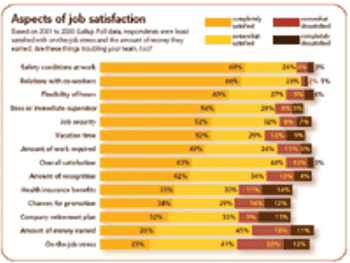
If your team members aren't feeling satisfied with their jobs, find out what's wrong?and find a fix.

We're taking our practices to the next level by introducing quality control protocols. Better control means better results, which gives us the foundation we need to be more than just a good hospital; we want to be great.

Encinitas, Calif. — Communication with staff is the key to a hospital's success, Dr. Michele Drake says.
It can be helpful for you to spend time in each type of practice before making your decision.
Don't let those New Year's goals slip away. Act now.

Give your team the freedom to make the practice shine.
After the storm
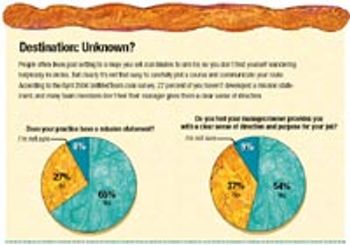
As the captain of your practice, it's your job to set the course and take advantage of the wind, urging the ship toward your destination. But you can't maneuver this behemoth alone. You need a crew. When they're truly onboard, your team members will have one eye on the horizon and another peeled for potential problems, and they'll help keep the practice on course.

A veterinarian I don't know that well offered me an opportunity to work for a clinic she's purchasing, promising that if we're compatible, she'll allow me to buy in. How do I formalize our agreement?

How do I know how much I need to save for retirement?
You can enhance your professional career every time you step up to the lectern—provided you've mastered the all-important basics of public speaking.

Prescribing the medicine is easier than taking it, but if you want to uphold your standard of care, you need to ditch your excuses.
The future is rife with new veterinary exploration. Dr. Lonnie King is a believer and a pioneer.
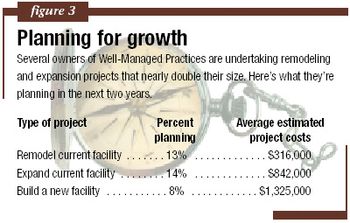
The 2005 Well-Managed Practice Study shows how important strategic planning is to achieving your practice vision-and respondents say their only regrets are not planning sooner.
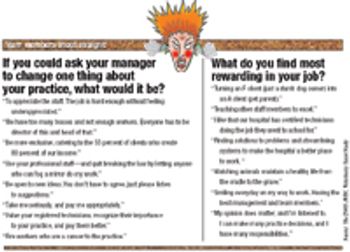
Take a look at the issues team members say bother them most. Then think about what you could do to make their professional lives easier. They'll pay you back-promise! (Attention associates: Boss driving your crazy? We've got ideas for you, too.)

Step one: Weigh the benefits and decide whether you're interested in ownership. Step two: Start developing critical leadership skills.
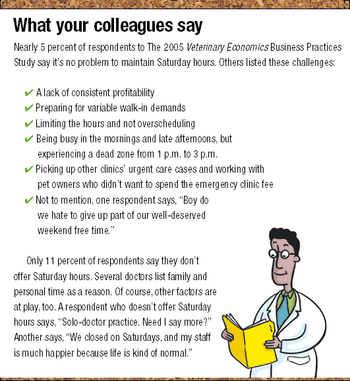
Almost 90 percent of you are are at work. Maybe it's time to buck the trend.

Data shows team members are in search of stronger leadership. So prevent kinks in teamwork and breaks in communication by taking these six critical steps—and set a positive tone for the practice.
According to Gallup's annual Personal Finance poll, American's top financial worry is retirement.

Enjoy a happy veterinary career by leaving your angst at the door.

Even small businesses create hundreds of transactions during a month. And when you add your personal banking to the mix, it's easy to become overwhelmed, especially if you don't like bookkeeping.

Think you're working too much? Odds are you're not delegating enough to team members-who are hungry to help.

When you remove barriers, you're free to realize your true potential.

During the first few years of practice, it's not unusual to dig through textbooks, go online, or read up on cases during spare time. But somewhere around the third year of practice, most of us gain a level of comfort with medicine that stems late-night reading. We go on autopilot.

Commit to these 10 culture changes to build a terrific practice.
Studies show morale and turnover improve when team members feel appreciated.

I've played hockey for many years, often once or twice a week. One day it dawned on me I wasn't improving. Instead I was doing the same wrong things over and over--I was playing but not practicing. Finally, I took a skills class and was amazed at how much I didn't know.
In prior articles, I gave advice on creating and writing a strong, compelling vision for your life and work. But crafting the vision is just the first step. Next you must figure out how to make your vision a reality.
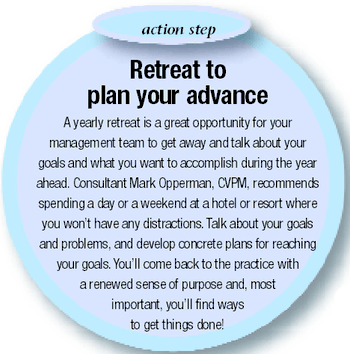
Work better with goal planning.