Help Shape the Future of Veterinary Education
|Articles|July 1, 2006

Minimizing owner taxes

We'd like to keep our salaries low in order to minimize Social Security and Medicare Taxes. What's the minimum salary we can take so the IRS isn't breathing down our necks?

I'm a partner at a four-doctor small animal clinic, and our workweek is 35 hours. We pay ourselves a minimal salary of $30,000 per year. We'd like to keep our salaries low in order to minimize Social Security and Medicare taxes. What's the minimum salary we can take so the IRS isn't breathing down our necks?

"It sounds like you're operating as an S Corporation for tax purposes, so your practice can pay owners both a wage and dividends, referred to as S Corporation Distributions," says Gary Glassman, CPA, a Veterinary Economics Editorial Advisory Board member and partner with Burzenski and Co. PC in East Haven, Conn. "You don't need to pay Medicare and FICA taxes on distribution amounts, only on payroll." So the lower the payroll, the less the payroll tax.

"But the IRS wants to see a reasonable salary subject to payroll taxes; otherwise, they view the distributions as a way to receive pay but avoid payroll taxes," says Glassman. You should view distributions as a return on your investment for being an owner, he says. You still need to pay a reasonable salary for providing veterinary and management services. "A reasonable rate may be what an associate would receive for performing similar duties," he says. Or look at the production generated by each of the partners and pay them at your standard rate of production."

Gary Glassman


Related to this article

Q&A: Caregiver burden can begin early in pet illness. Are veterinary teams equipped to support clients, and how can veterinary social workers help both parties?
Caroline Cox, LSW, MSW, and Erika Krick, VMD, DACVIM (Oncology), discuss the role of veterinary social workers in supporting clients, communicating with veterinary teams, and helping practices address the human side of veterinary care in this Q&A from an interview at the 2026 Fetch National Harbor Veterinary Conference.
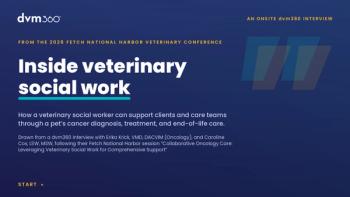
Inside veterinary social work
In a slideshow drawn from an on-site dvm360 interview at the 2026 Fetch National Harbor Veterinary Conference, a veterinary oncologist and a veterinary social worker walk through how the role supports owners and staff across a pet's cancer diagnosis, treatment, and end-of-life care.