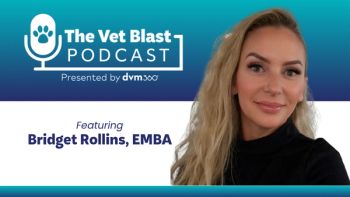
Knowing your triggers is the first step. Bridget Rollins, EMBA, shares how to move from heated to productive conversations that build trust rather than tension.

Explore the latest insights on the human-animal bond and veterinary care trends with experts from the Human Animal Bond Research Institute and Chewy Health.
On this episode of The Vet Blast Podcast presented by dvm360, Lindsey Braun, vice president of research and operations for the Human Animal Bond Research Institute (HABRI), and Tiffany Tupler, DVM, CBCC-KA, join our host Adam Christman, DVM, MBA, for the first show of 2026! In the episode, the trio takes a closer look at the results of a recent survey conducted by the HABRI to gain a better understanding of current trends surrounding the human-animal bond (HAB), how Chewy Health is working to bridge the gaps between clients and veterinary teams, and more.
Below is a partial transcript, edited lightly for clarity.
Adam Christman, DVM, MBA: From recording the highest-ever [HAB] score to uncovering what drives client satisfaction, what stood out to you most in the findings? And why are these results important for veterinary teams and the broader pet care landscape?
Lindsey Braun: We measured the [HAB]—the strength of it—using our HAB score, which is a 14-statement scale that gets at the 4 different dimensions of the bond: attachment, humanization, commitment, and integration. The highest possible score you can get is a 70, and we saw an average of 60 across these respondents. That's actually the highest average we've ever seen. We've done a number of surveys that include this measure, really indicating that the bond is stronger than ever. Maybe it's really no huge surprise. We know, even just asking the respondents, 97% of them indicated their pet was like family, [and] 90% reported health benefits resulting from having their pet. But the surprising thing wasn't that the bond is strong; it's actually that there are significant differences in terms of the strength of the bond.
We kind of grouped pet owners into strong, stronger, [and] strongest based on their responses. If you look at it on the chart, it's not a bell curve…folks are really clustered toward the top. But in terms of things like behavior [and] vet visits, those with the strongest bonds are more likely to visit the vet more often. Willingness to spend on pets is different, [as is] how they experience challenges. Those with the strongest bonds didn't necessarily experience more challenges related to pet care, but the challenges they did experience, they experienced more deeply and acutely. Then [regarding the] willingness to uptake technology, when it comes to addressing certain challenges through technology, they're more likely to be interested and already utilizing tech tools.
This matters to teams. Maybe it comes [as] no surprise, but understanding a client's bond can really help [you] be more effective in the care you deliver…not only the care recommendations but [also] what you offer in terms of tech solutions, for example. Understanding the bond can really help you deliver more effective and responsive care.
Christman: I can't get over that it's 60 of 70. That's huge. I mean, I'm not surprised, and…I go back and forth on that number, because I was like, “Wow, that really is higher than I anticipated,” which is good…. But is there anything in there about our pets being our “Velcro” pets?
Braun: …Well, their attachment is one of the dimensions. We'll get into a little bit about pet owners wanting to spend a lot more time with [them].
Christman: Let's talk about the emotional toll because, my goodness…I know that's important. But [there’s a] knowledge gap in pet health. Dr Tiffany, this is interesting. The survey showed that 82% of pet owners struggle to understand their pet’s health needs. So from a veterinary perspective, how does this knowledge gap impact care, and what role can veterinary teams play in closing that?
Tiffany Tupler, DVM, CBCC-KA: As a shelter veterinarian myself and a community educator, [I] see this a lot. So this, from our side, doesn't surprise us. When you think about where we are in veterinary medicine, we're very strong at what we do best, which is diagnosing, treating, and fixing animals. But the gap with what people know just about basic stuff…it's really difficult.
They don't know where to go for resources, and we have to remember [that] not everybody is a scientist, so they don't understand how to dissect what's good [and] what's bad information. Sometimes the best speaker or the best writer may be the winner of that. So as veterinary professionals, this is a huge area where we can impact not just veterinary care but [also the] human perspective. I mean, this is One Health medicine right here, right? So utilizing your veterinary teams, that's No. 1. So, how do we do that? Teach pet parents what good resources [are]….
Listen to the full episode to hear the rest of this conversation, and more!