

San Antonio - More than 4,000 practitioners are expected to ride into the American Association of Equine Practitioners (A?P) meeting at the 52nd Annual Convention, Dec. 2-6.
San Antonio - More than 4,000 practitioners are expected to ride into the American Association of Equine Practitioners (A?P) meeting at the 52nd Annual Convention, Dec. 2-6.
Nat A. White II, DVM, Dipl. ACVS, will present the Frank J. Milne State-of-the-Art lecture at the American Association of Equine Practitioners 52nd Annual Convention in San Antonio, Texas, on Dec. 4. Dr. White's lecture, "Equine Colic: A Real Pain in the Gut," will highlight the biology of equine colic and advances in its diagnosis and treatment. The lecture is sponsored by AAEP Educational Partner Platinum Performance and presented by the AAEP Foundation, Inc.
Rapid triage decisions and referral is a tremendous benefit to survival rates.
St. Paul, Minn. - The University of Minnesota (UM) is planning a $14-million horse treatment and research center that will house a riding arena, research barn, surgical suites and treadmills.
College Station, Texas - Laurie Jaeger, associate professor in the College of Veterinary Medicine & Biomedical Sciences at Texas A&M University, was named a 2006 Piper Professor.
Vet Medicine's December 2006 Radiography supplement REVISED
Lexington, Ky. - Researchers, industry leaders and funding agencies gathered to develop a blueprint for future success in equine research.
COLUMBIA, MO. - 8/22/06 - The number of equine West Nile virus cases as of Aug. 15, surpassed the number recorded for the entire season last year, according to Gayle Johnson, DVM, University of Missouri-Columbia (MU).
FORT COLLINS, COLO - 08/02/06 - A $1-million gift to Colorado State University's equine veterinary programs will be evenly split between the university's Gail Holmes Equine Orthopaedic Research Center and the Equine Reproduction Laboratory.
Washington - The Unwanted Horse Coalition is being folded into the American Horse Council (AHC).
New York - After five horse-related accidents this year - including one in January that put a driver in a coma and one in late April that knocked a 71-year-old man unconscious - Councilman Tony Avella of Queens plans to hold a hearing this fall on a resolution to restrict horse-drawn carriages to Central Park and its surrounding streets.
Pythiosis is notorious for being difficult to remove with surgery alone. "Usually that's the case because complete surgical excision without damaging vital anatomical structures is often not practical in the locations that this organism likes to establish infection," says Mathew P. Gerard, BVSc, PhD, Dipl. ACVS, clinical professor of equine surgery at North Carolina State University. "The main point about surgery for pythiosis is that it has to be radical excision if you're going to be successful. Wide surgical margins of at least 2 cm are recommended."
Many owners and trainers have never been taught how to properly cool a hot exercising horse. How hard can it be? Just hose it down with water, right?
A horse's skin and coat can be contaminated via air and soil by various fungal organisms. Though also found on normal horses, some of these fungal organisms can produce significant fungal infection under the proper conditions. From the commonly recognized ringworm to the more insidious pythiosis, horses can be infected by these potentially nasty fungal infections, which are not only irritating, but also in the case of pythiosis, can be life-threatening.
The AAEP recognized the unique issues of horses working in an urban environment, i.e. mounted patrols, tourist carriages and taxi/limousine services. Horses engaged in these activities require special work and living conditions and precautions for their safety and well-being. Urban environments present health and welfare hazards that may preclude their use, such as pollution, concussion, climactic extremes and load factors.
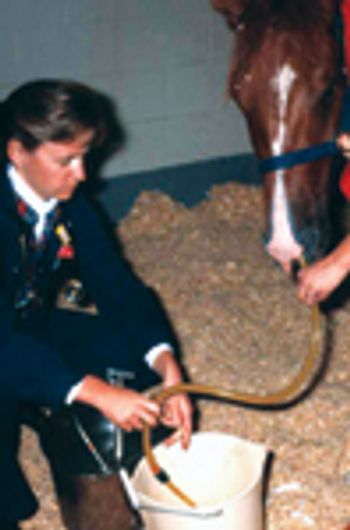
Slightly hypertonic water will stimulate the thirst center, impelling a horse to drink more overall water.
KENNETT SQUARE, Pa. - 7/10/06 -The plate and many of the screws that had been inserted into Barbaro's injured hind leg were replaced Saturday by Dr. Dean Richardson, chief of surgery, University of Pennsylvania.
Fecal egg counts (FEC) in horses are incredibly consistent for an individual horse, as shown recently from a three-year study in Denmark.
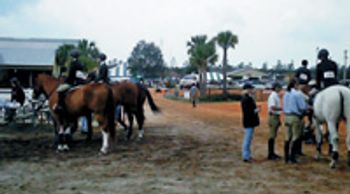
Wrmblood horses have proliferated dramatically in the last several years in North America. Increases in importation and breeding numbers have led to this surge in popularity. These Hanoverians, Holsteiners, Trakehners, Oldenbergs, Selle Francais, Dutch Warmbloods, Swedish Warmbloods, Irish crossbreeds and others are being used with increasing regularity in the dressage and jumper rings where their size, power and agility is sought and admired.
Not all horses are affected the same, probably 20 percent of horses shed 80 percent of the eggs.
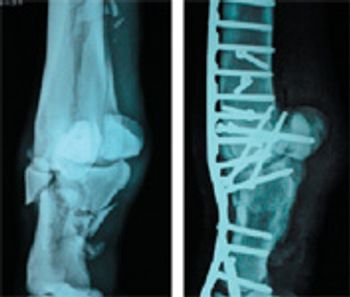
From the time his experienced jockey, Edgar Prado, gently pulled him up and kept him quiet while veterinary assistance arrived until this very day, Barbaro's new battle has been one of a convergence of fate, veterinary excellence and most of all, teamwork.
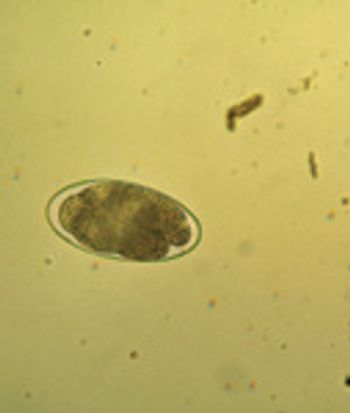
Overcoming clients' preconceived notions can be difficult, especially as newer research suggests that treating horses as individuals might be more effective than a shotgun deworming regimen.
PHILADELPHIA - 06/12/06 - For the first time, public money was used to improve the New Bolton Center at the University of Pennsylvania School of Veterinary Medicine.
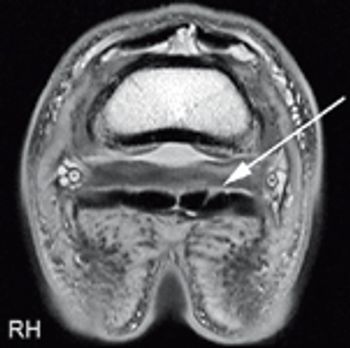
Though many experts believe magnetic resonance imaging (MRI) is underused in equine veterinary medicine, greater availability of the technology and access to interpretation experts are facilitating greater adoption, especially when diagnosing lameness.
Stifle injuries should be treated like tendon or ligament injuries in other areas of the horse.

Blacksburg, Va. - John Robertson, VMD, MS, PhD, director of the University of Virginia-Maryland Center for Comparative Oncology, is experimenting with frankincense oil as a possible treatment for malignant melanoma in horses.
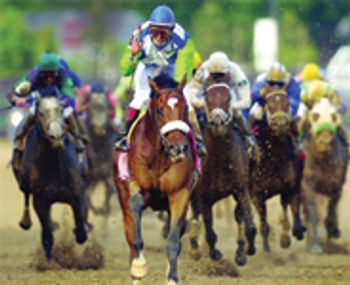
Louisville, Ky. - The Thoroughbred racing Mecca was amid heightened biosecurity following recent outbreaks of equine herpesvirus and a mysterious illness that claimed the life of Kentucky Derby contender With a City.
Magnetic resonance imaging (MRI) results from the effect of magnetic properties of atoms found in biologic tissues. The magnetic moment of the nuclei within these atoms interacts with the external magnetic field, the most common of which is hydrogen. Hydrogen is abundant in all tissues and has a relatively large magnetic moment, making it the optimal choice for magnetic resonance imaging.

Victoria, British Columbia - The Supreme Court of British Columbia issued a broad injunction that prohibits non-veterinarians from performing any dental procedures or using a title, such as equine dentist, that might lead people to believe they are registered under the territory's Veterinarians Act.
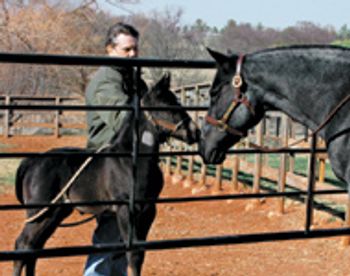
Austin, Texas - A partnership between ViaGen Inc. and Encore Genetics produced the first commercially cloned mare in the United States. Royal Blue Boon Too is the genetic replica of a champion cutter owned by Elaine Hall.