

















Boston -- Devocalizing a dog or cat without medical cause will be a felony in Massachusetts if Gov. Deval Patrick signs a newly presented bill into law.
Boston -- Devocalizing a dog or cat without medical cause will be a felony in Massachusetts if Gov. Deval Patrick signs a newly presented bill into law.
I am caring for a 4-year-old Westie that has become aggressive. The owner has requested extraction of all four canines or euthanasia. What are your thoughts?
Attention-seeking behavior: What an animal does to get attention from a person or other animal.
Perhaps more in behavior than in all other areas of veterinary medicine combined, there is a flurry of incorrect myths that are either at best unhelpful, or at worst harmful, to our patients. It is important that veterinary staff know the scientific background of behavior, and to not resort to the common thought, which is sometimes incorrect.
Animals are exposed to stressful situations throughout their entire lives. Not only animals in confinement encounter stress, such as in kennel or shelter situations, but those in households do as well. Behavioral enrichment helps decrease some of the stresses that the animals encounter, as well as playing a direct role in preventing and treating problem behaviors.
For many years, we taught clients who live with dogs who bite that the problem is likely 'dominance' – the dog is possessing over space, food or other resources to establish a hierarchical position. While some aggressive reactions may be due to the dog's perceived need to guard a resource, there is no evidence that interactions with humans aim at establishing rank.
There are an estimated 1100 off-leash areas in North America. There are both positive and negative aspects of behavior of dogs at dog parks.
In many cases, we ask our clients to change their ways, adapt new strategies, and adjust their interactions with their pet. Clients are at different stages of readiness to make changes.
Even the best veterinarian will eventually face a client who is disappointed, angry or frustrated.
In conversation, the terms 'anxiety,' 'fear,' and 'phobia' are commonly used synonymously. In the context of behavior medicine it is important to be mindful of their respective definition and differences between the conditions since they vary not only in presentation, but also in treatment and prognosis.
New research is changing our view of the cat towards a more social, group living model more typical of the way cats are currently living in human households. The way we categorize aggressive behavior in cats may change in the future.
Learning theory is not just theory...it is the scientific knowledge developed from the learning principles of habituation, classical conditioning and operant conditioning. This includes systematic desensitization and counter conditioning as well as types of punishment.
In social animals, aggression towards conspecifics is normal within the group and when dominance hierarchies change. Otherwise, a social structure keeps fighting to a minimum.
Cats who eliminate outside the litter box pose serious problems for owners that may force the family to place, surrender or euthanize the cat. In many cases, treatment is highly effective with resolution rates between 80-90% if the problem has been properly diagnosed.
Cats who eliminate outside the litter box pose serious problems for owners that may force the family to place, surrender or euthanize the cat. In many cases, treatment is highly effective with resolution rates between 80-90% if the problem has been properly diagnosed.

We will review the meaning and principles or reinforcement and punishment, using the 'Law of Effect".
Washington -- Researchers from the U.S. Department of Agriculture's Agricultural Research Service (ARS) have discovered that adding the amino acid tryptophan to the diet of female pigs can decrease their aggression, making them more manageable.

Do you think pets are just good company? They may be much more. Dr. Lynette Hart discusses the positive side effects of companion animals on humans in various situations.

Dr. Benjamin Hart discusses a problem commonly encountered by practitioners--fighting between a client's dogs. Dr. Hart considers one potential cause of this problem: the owner inadvertently undermines the pack hierarchy. He describes a method for quick resolution of aggression between two normal dogs whose owner has created instability and aggression by interfering with the social order. His advice: Show the dogs that you reinforce the same social hierarchy they do. Keep in mind that there are various causes of interdog aggression and that other causes will require different interventions.
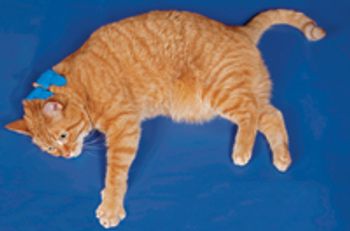
Using two-inch standard binder clips to induce pressure on the neck, just behind the ear, the researchers obtained positive results.
National Report -- A new genetic finding could help identify dogs at risk for compulsive disorder.
London, England -- A tour of the United Kingdom by Cesar Millan next year has prompted several U.K. animal welfare, behavior and training organizations to band together for a campaign that warns of possible dangers associated with some of Millan's training techniques.
Caring for young can trigger development of new neurons.
In this video, Drs. Lynette and Benjamin Hart discuss how they were inspired to research behavior in Asian elephants and what they've learned.
Behavior problems are often difficult for veterinarians to successfully treat and can cause owners endless frustration.