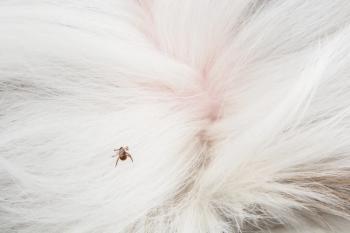
Overall, A maculatum demonstrated significantly greater survival times than A americanum across all flooring types. Mean overall survival was approximately 18 days for Gulf Coast ticks and 11 days for lone star ticks. Flooring type had a notable effect on outcomes:
- A maculatum survived longest on vinyl (mean ~25 days) and shortest on long-pile carpet (mean ~10 days).
- A americanum survived longest on long-pile carpet (mean ~15 days)—an unexpected finding—and shortest on tile (mean ~7 days).
- Minimum survival across both species and all flooring types exceeded 7 days, confirming that no common indoor surface reliably eliminates the risk from hitchhiking ticks in the short term.
Presumed cause of death in all cases was desiccation, consistent with the known physiological vulnerability of ixodid ticks to low ambient humidity.
Clinical takeaways for veterinarians
This study provides evidence-based support for several recommendations that veterinarians are well positioned to deliver at every wellness and sick-patient visit, including the following:
- Reinforce year-round tick preventive products for dogs and cats, with particular urgency for patients in tick-endemic regions.
- Advise clients to perform a thorough full-body tick check on pets immediately upon returning indoors, using a fine-toothed brush or lint roller as an adjunct to manual inspection.
- Recommend that clothing worn outdoors in tick habitat be placed directly into a dryer on high heat or sealed in a bag before laundering.
- Counsel clients that tick detection and removal upon entry — not after a delay — is essential, as ticks not removed before entering the home may survive long enough to find and feed on household members.
- Discuss the zoonotic significance of both A maculatum and A americanum, especially for clients with known α-gal sensitization or those at elevated risk for tick-borne disease.
Disease Transmission Context
The 2 species studied carry clinically meaningful zoonotic pathogens. A maculatum is a recognized vector for Rickettsia parkeri, which causes an eschar-associated spotted fever illness in humans. A americanum transmits Ehrlichia chaffeensis and E ewingii (causative agents of human and canine ehrlichiosis, respectively) and is responsible for inducing α-gal syndrome—a sensitization to galactose-α-1,3-galactose that can produce delayed anaphylaxis following consumption of red meat or other mammalian-derived products.
Both species are endemic across the eastern and south-central United States and feed opportunistically on a wide range of mammalian hosts, including dogs and cats.
The broader public health landscape underscores the urgency of these findings: The CDC has reported a 40% increase in total reported tick-borne disease cases in the United States between 2019 and 2022.
Limitations and Future Directions
The authors acknowledge that indoor environmental conditions vary considerably between households, as differences in HVAC systems, humidity levels, and temperature will affect actual tick survival duration. The findings establish a lower bound for survival risk rather than a precise prediction for any given home. Future studies examining additional tick species (including Ixodes scapularis, the primary vector for Borrelia burgdorferi and Anaplasma phagocytophilum) and nymphal life stages would extend the clinical applicability of these data.
“The ultimate goal from a public health perspective is to reinforce that ticks brought into the home on pets or people could be a risk,” Pesapane said. “Hopefully having some data around that will compel people to say, ‘OK, doing tick checks is really important.’”
Reference
Sabet A, Pesapane R, Ward SF. Effect of floor type on survival of Amblyomma maculatum and Amblyomma americanum (Acari: Ixodidae). J Vector Ecol. 2026;51(1):12-21. doi:10.52707/1081-1710-50.1-12