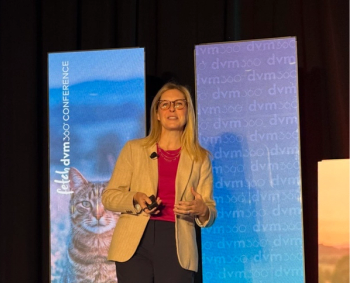
Krebs: Full disclosure, the canine and feline guidelines are not super new. The feline guidelines [were last updated in] 2020, and I guess we can start with cats because cats always get the short end of the straw. A couple of big changes in the…2020 feline updates—one is around FVRCP vaccines. One of the big recommendation updates is recommending that kittens get another FVRCP booster at 6 months of age, whereas historically, we would stop between 16 [and] 20 weeks of age. Now they're recommending an additional booster just because about one-third of kittens will still have maternal antibodies at that 16- to 20-week age, so we can’t and don't really know what kittens will be fully protected and what kittens won't. So by giving them that additional booster, then we can ensure that all the kittens are protected.
The other feline change is around the FeLV vaccine. The change…is to include FeLV as core for all kittens [younger than 1] year. That means they get their first 2 doses in that kitten series and [a] booster at [1] year. Then once the cats are a year [old], it becomes a lifestyle vaccine, which is historically how people have thought of FeLV vaccines…based on what that cat is doing out in the world.
So those are really the 2 big changes around the feline guidelines. And [when I speak about vaccines to veterinary audiences], it's always interesting to me…how many people know about those changes…and…how many people implement those changes. And it's actually a lot fewer veterinarians than I would expect. Usually, we think of those guidelines as…top-of-the-line recommendations from vaccine experts, so I think on the feline side, people have been a lot slower to make those changes.
On the canine side, the biggest change is around lepto. The canine guidelines were initially updated in 2022. [The American College of Veterinary Internal Medicine] came out in 2023 with an updated lepto statement recommending lepto as core for all dogs, and then [the American Animal Hospital Association] Canine Vaccine Guidelines were updated in 2024. That was to update leptospirosis core for all dogs, regardless of their lifestyle, and I think in the veterinary world, people have been a lot more willing to update their vaccine protocols to include lepto as a core vaccine. I think before the guidelines, most of us were doing that and treating lepto as core anyway.
So on the canine side, it was a lot smaller of a shake-up, and people really do follow those guidelines…. It's been 2 years since those guidelines were updated, and I still am talking to people that don't consider lepto as core yet, so it's still a major change.
dvm360: Do you have any thoughts on why that contrast is the way that it is—such as why people tend to be more likely to adopt the canine guidelines quicker than the feline—or do you think it is because it’s lepto vs FeLV?
Krebs: In general, it's a lot easier to get dog owners on board with giving a vaccine every single year. When I'm speaking to dog owners, I can say, “Hey, [there’s been an] update: Lepto is core. You're coming in for your annual vaccines anyway. This doesn't change anything that we're already doing for your dog, other than giving them a vaccine that we're already recommending.”
On the cat side, it's a little more difficult to get cats into the vet in general, and I think we were seeing that it's a little more challenging for them to come in for their annual exams. We don't see cats every single year, [even though that's our recommendation], and even if they're not getting vaccines, they should be coming in for their wellness checks every single year. So, as kittens especially, it's a little more challenging to get owners to see the value in those added vaccines. And I think from the veterinary side—the FeLV vaccine, especially—it's challenging, and I've seen this in my practice also. It's hard to convince cat owners that we need to give these vaccines, and our talk [at the 2026 American Veterinary Medical Association Convention] was about vaccines and the differences. I do a lot of talking on vaccine hesitancy. That's something that both [White] and I are actually studying in a project this summer. I think we just see a little bit more of that in the cat world.
And for whatever reason, cat owners are a little harder to convince. I think veterinarians also perhaps don't see the value in doing FeLV, so [they] don't push as hard to vaccinate those cats as well.
White: I would agree. I think it's definitely…asking them to come for that additional booster after they've already come for the kitten series. It's about the additional visit. Then I also think people sometimes, with cats, have a reduced perception of risk because the cat is indoor only, and maybe they…think they don't need these vaccines because they don't have that outside contact, but that's not entirely true all the time.
dvm360: Are there any core vaccines where recommendations have shifted, or is this mostly about refining protocols for noncore vaccines?
Krebs: That does differ depending on whether we're talking about dogs or cats. If we start with cats, we do see a shift in core vaccines with the updated guidelines, because FeLV is considered core for kittens [younger than 1 year], and then we do change the timeline of the FVRCP vaccine, which is considered core for all cats. So it's kind of a multilayered answer. Even though FeLV is typically considered noncore, we're adding that in as a new core vaccine for kittens, but it remains noncore for older cats. So it's a little difficult to fully determine if that's a shift in one or the other. I'd call it a shift in both.
On the canine side, it's a lot more cut and dry. We're adding lepto as core, whereas before it used to be noncore. So it's not necessarily a new vaccine, but it is a change in the recommendations for our core vaccines, so we're just adding that into what we consider important for all dogs.
dvm360: Was lepto not a core vaccine originally because it was more location-based, or what was the reasoning behind that?
Krebs: Lepto wasn't considered core before, but I think mostly from a risk analysis standpoint. People historically thought that only our large-breed hunting dogs that are out in the wilderness hunting and interacting with wildlife…were the dogs that were most at risk of getting lepto.
But as we do more research, as we get more information, we have seen that shift to lepto being seen more in our little white fluffies living in the city, living in apartments, and those dogs are just as much at risk as our dogs that are out interacting with wildlife…. What I like to tell my clients is that lepto is everywhere. We have rats in cities. We have wildlife that spread it. Even if you don't think your dog is interacting with wildlife, if your dog comes down from its 18th floor…apartment and pees on the grass outside, they are certainly coming into contact with areas where wildlife—whether we think of wildlife as a rat or a mouse, it is—and they're coming into contact with areas where those animals have been, which puts them at risk. So all dogs, regardless of where they live, their size, what their lifestyle is like, are at risk of getting lepto, and that's why we've made that change.
Want to hear more from this conversation? Be on the lookout for part 2 coming later this month!