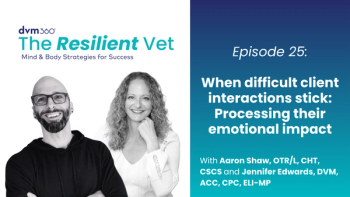
Veterinary medicine is demanding by nature, but chronic stress, physical strain, and workplace fatigue do not have to be accepted as part of the job. In this episode of The Resilient Vet: Mind and Body Strategies for Success, cohosts Aaron Shaw, OTR/L, CHT, CSCS, and Jennifer Edwards, DVM, ACC, CPC, ELI-MP, discuss how practices can move beyond one-off wellness efforts and instead build systems that support long-term durability. Shaw breaks down his Durable Vet Team Blueprint—built on protection, fueling, and strengthening—and shares practical strategies to reduce workplace strain and improve team well-being. Topics include ergonomics, nutrition, strength training, leadership, and building a healthier clinic culture through sustainable daily habits.
Below is a partial transcript, lightly edited for improved clarity.
Shaw: This is where it gets real. It takes a little bit more effort, in a sense, but it’s really about creating structure and installing it. It’s not about giving a wellness talk or bringing your team together for a lunch-and-learn. It’s not having a poster that says, "Here are some safety things," or "Here’s how to eat well so you have energy all day."
It’s really about standard operating procedures—SOPs—that are built into the culture of what people do day in and day out. We're talking about behaviors that are practical, observable, and repeatable. These behaviors live inside the workflow rather than being something external. Again, that is where the "lunch-and-learn" concept falls short: those things are outside of the day-to-day work. Worse yet, when people are already super busy and leadership—with a heart in the right place—says, "We're going to shut down the clinic and walk around the building for 15 minutes to get some fresh air," it can backfire. While that isn't a bad thing to do, if you’re doing it on top of everything people are already doing, a good intention can feel like just one more thing.
We have to weave this into the moment-to-moment, day-to-day flow. I’ll give some examples through 3 of the pillars I talk about in my product, the Durable Vet Team Blueprint. The blueprint is a pathway to help install this into clinics. The 3 pillars we’ll cover are:
- Protection: Just protecting our bodies. It’s no secret that most of us professionals have a certain amount of aches and pains from the work we do.
- Fueling: [This encompasses] nutrition.
- Strengthening: How we literally strengthen our bodies so the work actually feels physically easier.
When we talk about installing these things, we need to make sure our targets are reasonable. We have to be a little humble and patient, because change takes time. We want to ensure the behaviors we're talking about are triggered by things that already happen in the workflow. We’re not trying to force a bunch of new stuff; we’re trying to recognize habits and rituals—like when patients come in or are discharged—as points in time where we can say, "This is a good time to do X to be more durable and safer."
Of course, this has to come from leadership. It’s about modeling the behavior we want, reinforcing it, and being free to speak about it. I think one of the most freeing things in the world—not to go too deep into communication skills—is when a leader can speak to the team and say, "I am going to work to help us be more physically and emotionally resilient and durable. Bear with me as we all work together." Putting it out there on the table is empowering from the get-go, and it gives you a little bit of grace, too, because you can just say, "We’re all going to learn as we go."