
Migraine caps, eye masks, and wraps may carry a hidden neurotoxic risk for dogs.
A recently shared Pet Poison Helpline case traces how a wild mushroom eaten on a walk left a dog unable to stand within hours, and how the team treated it.
A dog that ate most of a wild mushroom during a walk near her home showed no signs of trouble at first. A few hours later, she couldn't stay on her feet. That's according to a case shared by Pet Poison Helpline, which says the mushroom was later identified as Amanita pantherina.1
The dog, Sammy, found the mushrooms in field grass while out with her owner, Taylor Sisson. Sisson told the poison control center that she pulled the mushroom from Sammy's mouth once she noticed it. By then, most of it was gone.1
"I didn't notice her eating anything," Sisson said. "When I realized she had a mushroom, I took it out of her mouth, but she had already eaten most of it. I threw what was left in the forest and didn't think much more about it and went home."1
Sammy started panting and acting abnormally a few hours after the walk, according to the release.1 Once she went back outside, her condition got worse.
"When I took her back outside, she fell over," Sisson said. "She couldn't walk and she was acting like she was drunk. She kept falling over."1
Sisson remembered the mushroom and went back to look for what was left of it, but she couldn't find anything.1 She called her regular veterinarian, who said Sammy needed emergency care and suggested she contact Pet Poison Helpline. The poison control center also advised immediate treatment and helped Sisson find an emergency hospital while she drove. According to Sisson, she was told to be ready for Sammy to start having seizures.1
Toxicology staff at the poison control center helped identify the mushroom as A pantherina.1 The release states that most confirmed fatal mushroom poisonings in pets involve mushrooms from 3 genera: Amanita, Galerina, and Lepiota.1
Renee Schmid, DVM, DABT, DABVT, a senior veterinary toxicologist and director of veterinary medicine at Pet Poison Helpline, said in the release that identifying mushrooms by sight is unreliable.1
"Although some mushrooms may be edible, it is better to assume they are all poisonous to our pets since they are often difficult to identify," Schmid said. "Clinical signs of mushroom poisoning may include vomiting, diarrhea, salivation, abdominal pain, hallucinations, tremors, and seizures. In some cases, ingestion can lead to liver failure, kidney failure, and death."1
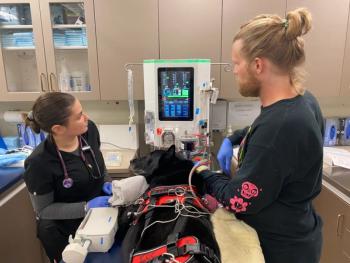
Sammy arrived at the Emergency Veterinary Hospital of Coeur d'Alene in Idaho ataxic and lethargic, with hallucinations and tremors.1 The team started intravenous fluids and gave her an antiemetic and medication for the tremors. The poison control center also recommended monitoring her bloodwork and treating any additional clinical signs that developed.1
Sammy responded to treatment and went home the next day. The release states that without treatment, her neurologic signs likely would have progressed and led to further life-threatening abnormalities.1
"Between Pet Poison Helpline and the amazing medical team at the hospital, they saved her life," Sisson said.1
Sammy was diagnosed with cancer months after she recovered and later died. Sisson said in the release that she chose to share Sammy's story anyway, because the treatment bought the family extra time with their dog.1
References