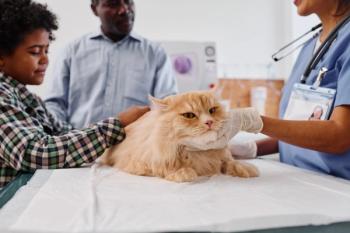
The Positive Preventive Veterinary Experience Protocol approach combines environmental changes, pain-reduction techniques, sensory distraction, and positive reinforcement to make preventive visits less stressful for pets and their owners.

Alyssa Mages, BS, CVT, FVTE, shares guidance on assessing emergency patients, communicating with distressed clients, and establishing a team-based triage process.
How a practice structures triage affects how quickly patients are stabilized and how well clients are kept informed. Alyssa Mages, BS, CVT, FVTE, cofounder and chief visionary officer of Empowering Veterinary Teams (EVT), spoke with dvm360 at the Fetch dvm360 Veterinary Conference in National Harbor, Maryland, about her session, “EVTriage! Evaluate the Patient. Calm the Clients. Notify the Team. Treat the Patient. Repeat!” including what to assess when an emergency patient arrives, which findings call for immediate escalation, and how practices without a formal triage system can build one.
Editor's note: This dvm360 Q&A has been edited and consolidated from a verbal interview to better fit a written format while retaining the substance of the original conversation.
dvm360: When an emergency patient first arrives, what should a veterinary technician assess in the first few minutes to determine urgency?
Mages: When we're talking about the principles of triage, what you're really wanting to make sure is you have a standardized approach for every patient, every time that you do it, similar to a physical exam. If you're starting from the nose and going to the tail, it's essentially what you want to translate into the triage process.
It's kind of thinking of TPR in a different way. Instead of temperature, [pulse], respiration—you need those too—it's thinking of timing, priority, and what your response is going to be. What is the most urgent? What is the most timely thing that you need to take care of? And how are you going to respond to it?
So taking a look at comparing, say, a heat stroke patient versus an ear infection, clearly the heat stroke patient takes precedence. The ear infection can wait. It's how you communicate that. It's how you utilize your team members' skills and make sure that everyone from your reception team to your veterinarians are on the same page, and everyone knows what to do, when to do it, and how.
dvm360: Which findings during a triage assessment should prompt a technician to escalate immediately?
Mages: It's a pretty subjective thing. It's going to depend on what the patient is presenting with and what the standards are at that practice. But typically, you want to make sure [you know]: What is their respiration rate? What is their pulse quality? Are they even breathing, first of all? Are they open-mouth breathing? That is never normal in a cat. Is there active bleeding? Was it a call-ahead, and you know what's happening? Is it a blocked cat? Is it a seizure patient? What are all of these things? Knowing what the physiological response is in your patient then determines what your actual response needs to be.
How fast you move matters, especially in terms of oxygen deprivation. You need to get them assessed and treated within 30 to 60 seconds while you're getting a history, and that's why you need to have a team involved in that process. It's making sure that you get the information, you assess the patient thoroughly, you get them back for an initial exam with the veterinarian and the technician team, you get them stabilized, you communicate with the client, and that all needs to happen simultaneously. It should never rest on any one person's shoulders. It needs to have the whole team involved.
dvm360: How can technicians communicate with distressed or anxious clients while still gathering the information they need?
Mages: Calmy, and kindly. This is when you have to really check in with your emotional intelligence, like your EQ over your IQ. It's making sure that you can defuse the situation as much as possible while focusing on the patient.
And this is again why I keep bringing back the team approach. If you can have one of your CSRs [client service representatives], your reception team, involved in this process and they're trained to do so appropriately, [that helps]. Everyone should have communication training, not just, I took a personality assessment quiz, and I know that I'm a DI in the DiSC profile. That's important, but you need to practice it. You need to role-play it.
So you have 2 team members involved. You have the one that is stabilizing and assessing initially with the patient, while the other team member is talking to the client. But always, regardless if you're having the direct communication or not, you're keeping them in your periphery. You're making sure that they're also a part of the prioritization process, and they're aware of what's happening at every stage. Because there's nothing worse than worrying about your fur baby, and you're not a part of that situation.
dvm360: For practices without a formal triage system, what key roles and workflow steps should they establish?
Mages: When you are developing a triage process—and this is not simply for emergency practices or urgent care facilities—when EVT is working with any practice, we train with an emergency mindset, mostly because that's my background, and the majority of my team's background is in emergency and critical care.
What you need to establish is a timeline. You need to have role clarity: who does what, when, where, why, and how. You need to have scripts ready. You're not reading off of a paper, but you need to know what to say and how to say it.
You need to be very well versed in what the top emergent things are that you will see, like vomiting and diarrhea, collapse, things of those regards. [It's] understanding what it looks like in a cat versus a dog, because cats are not small dogs. Understanding that a Chihuahua is going to present differently than a Great Dane, and what this means. You have to know the science behind it, and it's in different levels. A veterinarian is going to know different aspects than a technician, than an assistant, and then a receptionist. But everyone, on the high level, needs to be in the same place.
So you need to establish who is doing what. You have your roles. You need to have a formal triage form, whether it's digital or paper, and you need to have that workflow so everyone knows what to do and when to do it, and how it should work smoothly.
dvm360: What are the key takeaways you hope attendees left your triage session with?
Mages: I'm hoping they walked away with a sense of, it's not on one person to perform a triage, to be the triage technician. It is a team-based approach. That's how it's going to work most effectively. And really recognizing that while veterinarians are vital to this, it's not their active role, right? They shouldn't be doing the initial intake exam. They shouldn't be having the conversations with the clients. That's why you have a team.
Really recognizing that every member of the team, from the receptionist to the assistant to the technician and the veterinarian, all need to work together so it works. Efficiency goes up when teamwork is present.