Senior pets rarely come in with just one problem. Nutrition that addresses cognitive decline, joint pain, and coexisting conditions together can help keep aging patients sharp, mobile, and engaged.
Ashlie Saffire, DVM, Diplomate ABVP (Feline), discusses diagnosing and monitoring feline hyperthyroidism and how Felanorm (methimazole) Oral Solution helps caregivers and clinicians manage the disease.
Ashlie Saffire, DVM, Diplomate ABVP (Feline), explains why feline hyperthyroidism is often caught before clinical signs appear and why the best treatment is one caregivers can give. She also covers how Felanorm (methimazole) Oral Solution allows precise dose titration for cats with comorbidities like chronic kidney disease.
Below is a partial transcript, edited lightly for clarity.
Adam Christman, DVM, MBA: Welcome to Product360. Dr Adam Christman here, chief veterinary officer for dvm360. We want to thank our friends at Virbac for sponsoring this great conversation as we talk about Felanorm (methimazole) Oral Solution with the one and only Dr Ashlie Saffire. Thanks for joining us, Doc.
Ashlie Saffire, DVM, Diplomate ABVP (Feline): Hi, I'm excited to be here.
Christman:To our listeners and those tuning in, Dr Saffire graduated from The Ohio State University College of Veterinary Medicine and is board certified in feline practice by the American Board of Veterinary Practitioners. She's a published author, an international speaker on feline medicine, and a tutor for the University of Sydney's feline distance education program. She currently serves as the immediate past president of the Feline Veterinary Medical Association. Dr Saffire is the founder and co-owner of Faithful Friends Veterinary Clinic and Cat Specialty Center, an AAHA-accredited, Gold-level Cat Friendly Practice in Dublin, Ohio. As an invited speaker, Dr Saffire hopes to share her clinical experience and expertise in feline medicine with the veterinary profession. OK, we're going to chat about feline hyperthyroidism. Dr Saffire, I know we see it quite a bit. How often do you see it across your exam table?
Saffire: I'm a little biased because I only see cats, and I see a lot of senior cats. But generally speaking, prevalence numbers we're looking at are like 10% of cats over the age of 10 are going to have hyperthyroidism, and honestly, I feel it's probably more than that because cats are living longer now. We have better diagnostics. We're catching this disease sooner. Cats are living longer. They're living long enough to get the disease.
Christman: Right. And hyperthyroidism often gets described as an epidemic of thyroid disease. Tell us a little bit more about that. How common is this reality, and which cats are most at risk?
Saffire: There are still a lot of people looking into what's causing this disease because we see it so frequently, and there are a lot of theories out there. Is it exposure to certain things like canned foods, or is it in things that cats are exposed to, like the fire retardants on our couches and carpeting? No one's really been able to identify what the underlying cause is. It could just be old age, right? Cats are living longer, so there's not really a good answer for that right now. I think there's still a lot of research out there trying to figure that out.
Christman: Yeah, and I feel like we're catching it a little bit better because we're doing a lot more senior wellness screenings. Is that what we're seeing, that we're starting to catch this earlier than we used to? Is that more common?
Saffire: Yeah, we're starting to see a lot more cases in the more subclinical phase, where we see these small changes in thyroid levels. When you trend over time, you get used to a patient's normal thyroid level, and then you start to see these really subtle changes, often before the caregiver even notices clinical signs at home. Or maybe we're not seeing much on the cat—maybe just very mild muscle loss or weight changes. So sometimes it's super subtle, and it can be a little challenging to diagnose when it's really early.
Christman: Right. Let's chat about that for a moment, too, with confirming the diagnosis. Where does it get tricky?
Saffire: Well, sometimes we can see normal fluctuations day to day. So you might run a thyroid level on a cat, and it could be a little bit higher than what its normal is, which might land you in that gray zone. That could be just a normal day-to-day fluctuation, and that can be really challenging to interpret, especially if the cat is subclinical and doesn't have a ton of clinical signs yet to support a diagnosis. So a lot of times we're left with, "Hey, I noticed this change. We want to get that cat back in in a couple weeks to either repeat some lab work or maybe try a different lab option." Total T4 is our normal screening test, but now we've got access to even better tests, like the thyroid-stimulating hormone test that's now available just for cats. That can really help narrow down that diagnosis and get your answer sooner. But sometimes you repeat blood work in a couple weeks, the cat's weight is stable, the thyroid's back down to normal, and it's not thyroid. So it's really important that you follow these cats closely, especially if you're suspicious or if you do see clinical signs that might suggest that this cat is developing hyperthyroidism.
Christman: Right, and I know that there are different ways of treating hyperthyroidism. Share with us a little bit about that.
Saffire: Yeah, we still have the same big 4: we can use an iodine-restricted diet, we use methimazole as a medication for medical therapy, we can do surgical thyroidectomy to remove an adenoma, and radioactive iodine. And remember, about 95% of the time it is a benign adenoma. About 5% end up being carcinoma. So sometimes that can affect what choice you use for treatment.
Now, most people will choose methimazole as the initial treatment choice for cats. It's a great option to stabilize the patient right off the bat, and it's reversible if a problem arises during treatment. It gives us time to see how that cat's going to react, especially their kidneys, as we start to drop that thyroid back down to a normal range.
One of the things we have to think about when we are choosing medical management is that a treatment only works if the caregiver can get the treatment into the cat, and there are a lot of options out there for methimazole. We have oral tablets or pills, we have transdermal medications, and we have oral solutions. We have to be really careful whenever we're compounding meds, though. I always remind people that when there's an FDA-approved product on the market, that's really the one we should be going for, because we know that product has been tested and there's consistency to the medication.
We have to be really careful with transdermals. Although they're an attractive option, a lot of times people don't realize that there is a human exposure risk. The methimazole transdermal can actually migrate through the ear, and the residue can be on the back of the ear pinna, which could expose humans if they're petting their cat on the head. Also, there's not really any consistency between the different pharmacies that make it. You can get separation of product, and that can be really frustrating when trying to get these cats regulated. So that can be a real drawback.
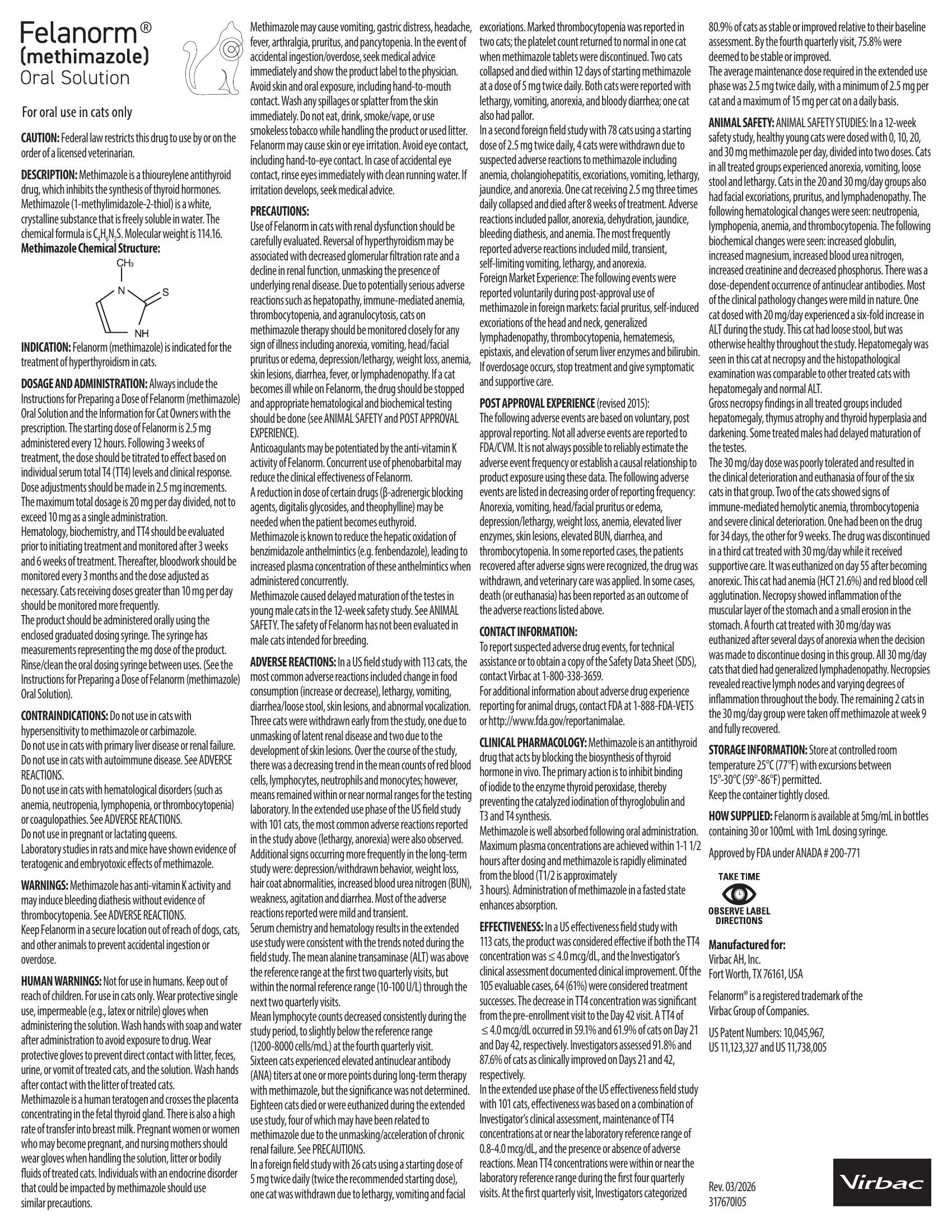
Tablets can be challenging to give. We know from surveys that some caregivers are really good at giving tablets or pills, and some are not. And then oral solutions can be a really good option, especially in giving you that ability—and for me, as a feline veterinarian, I always want the ability to titrate my doses. I always want to make sure I'm giving the very exact dose that I need. So it allows us to pick something like a 2-mg dose or a 3-mg dose, where sometimes the tablets have you set at 2.5 or 5. So it's a great option. And when it comes to oral solution, Felanorm (methimazole) Oral Solution is the only FDA-approved liquid methimazole for treatment of feline hyperthyroidism.
Christman: And for pet owners, when we're managing medically, is that a cure?
Saffire: Great question. We are treating the thyroid disease; we are not curing them with methimazole. It's management of the disease itself. The big thing that a lot of caregivers don't understand, though, is the thyroid gland when they have an adenoma that is growing—and 95% of the time it's an adenoma, which is a benign growth; 5% or so are going to be our carcinomas. But over time, that adenoma continues to grow, and they're going to continue to have fluctuations in thyroid hormones. It's really important when they're on therapy that we are rechecking thyroid levels pretty consistently, every couple of months, to make sure that if small changes or adjustments are needed in that methimazole medication, we catch that on time and we're able to keep the cat as stable as possible.
Christman: OK, let's talk about the compliance challenge. I always tend to say that a treatment plan works only if the caregiver can actually do it. What tends to get in the way with this?
Saffire: Oh, that's so true, right? I see a lot of patients, and a lot of times I want to give a lot of treatments. But if that cat is not going to be able to accept that treatment, or the caregiver is unable to administer it, I can't do anything for the patient. And that's something really important every time you're faced with a cat that you diagnose with a disease, especially hyperthyroidism. We can treat this disease pretty easily, but we've got to be able to get the medication into the cat. And there are a lot of formulations out there. We know that pilling with tablets can be challenging, so there are other options. Liquid suspensions seem to be much better tolerated, or they seem to be a little easier for caregivers to give, in some surveys that have been done. There are also compounded medications, but we have to be careful with compounded medications, especially when there are already FDA-approved treatments available. Not all compounded meds are created equal, and that's something we can't forget about either.
Christman: And that leads us to talking about Felanorm Oral Solution. What is it, and why is it a fit for this long-term compliance problem?
Saffire: Yeah, oral solutions can be really helpful for treatment. Felanorm is a honey-flavored oral solution that is very easy to give. What I like about it is that it has very specific 0.25-mg increments on the dosing syringe. So for me, as a practitioner, when I'm trying to decide on a dose, I don't have to make a jump the way I do with some tablets, from 2.5 to 5. I can actually choose 2 mg if I wanted, or 3 mg as a dose, which is really nice, especially when you've got cats with comorbidities like chronic kidney disease and I need to be really careful with how I dose the methimazole.
Christman: And does the research tell us anything about what owners actually prefer when it comes to giving medication?
Saffire: Yeah, there have been several studies and surveys looking at caregiver burden and medication administration. Oral liquid products are generally better accepted by caregivers, or they tend to prefer those. They're a little bit easier to give in some cases. And actually, Felanorm received an Easy to Give award from ISFM, which is a really neat thing. It just again supports how much easier it can be to give an oral solution versus something like a transdermal or a pill or tablet.
Christman: Nice. And it comes in 2 sizes. How does that play out in practice?
Saffire: The bottles come in different milliliter sizes. Sometimes when you're getting started, you want a smaller bottle, or some practices like to carry smaller amounts. If the medication is well tolerated, then for easier administration or longer-term use, you can get larger bottles, which is nice for caregivers—more economical, so to speak. And again, it's nice because once we start them on an oral solution, it allows us to really titrate based on how the cat is doing at their rechecks. As far as rechecks go, once I get them started on a treatment, I like to see them back in about 3 to 4 weeks. Give them some time to get used to medicating, give the cat time to stabilize, and then we usually get them back in for a recheck, see where their levels are, and make changes based on those results.
Christman: Nice. And let's talk about monitoring and the comorbidities that you alluded to before. Once a cat is on treatment, what does good monitoring look like, and on what schedule?
Saffire: Yeah. When I'm monitoring thyroid, there are a lot of things I have to think about. It's not just, "I'm going to see you back in 6 months or once a year," right? I really need to look at this patient. What were the clinical signs? Are we watching for clinical signs to get better? Were there any abnormalities on lab work that we want to see get better? Anytime I make a dose adjustment or start the medication, I want to see that cat back about 3 to 4 weeks after we've confirmed they've had consistent dosing. If it's a kidney patient—that's a big comorbidity that we see frequently with our hyperthyroid cats—I may check them a little bit sooner, maybe closer to 2 weeks in some cases, just to be really careful to watch for any development of azotemia. But generally speaking, I'm going to check about every 3 to 4 weeks anytime I adjust the dose, and then from there, about every 4 to 6 months I'll be monitoring that cat, usually with some lab work, a physical exam, and a clinical sign investigation to see how the cat is doing at home.
Christman: OK. And what comorbidities travel with the disease that clinicians need to keep on their radar?
Saffire: Anything a senior cat can get, I'm always on the lookout for. Hypertension is a big one. A lot of cats can actually start with hypertension, and then once their thyroid is controlled, that can go away—or vice versa: we can have normotensive cats that are treated for their hyperthyroidism and then become hypertensive. So we always want to watch for blood pressure changes. Diabetes is another one that can mess with your ability to assess your patient's response to treatment, so if we've got diabetes, we need to be really careful there. Chronic kidney disease, as I mentioned, can also complicate things. There used to be a saying that we would keep the cat a little bit hyperthyroid—just a little hyperthyroid—to protect the kidneys. But we're finding out now that if you leave those kidneys at a mild hyperfiltration rate, in mildly treated hyperthyroid cats, you can actually do more harm than good over time. So it's always best to fully treat any comorbidity that cat has and make sure that they're both being treated appropriately.
Christman: Yeah, absolutely. If you could leave veterinarians and cat owners with 1 takeaway about managing this disease well, what would that be?
Saffire: The biggest thing is we don't want to interrupt the caregiver–human-animal bond with their cat, so choosing a medication that's going to be easy to give, that's going to treat the disease we're trying to t
reat, and doing it in a successful manner—that's most important for me. That's one of the reasons that I love Felanorm: because of the honey flavor, the oral solution makes it easier to administer, and I can titrate it the way I want. So it's a great option for these hyperthyroid cats.
Christman: Excellent. And for anyone who wants to learn more, where should they go?
Saffire: Well, they can visit vet-us.virbac.com. It's a website that has more information, or reach out to your Virbac representative in your area.
Christman: Dr Ashlie Saffire, thank you so much for joining us, and thank you to Virbac for supporting this great conversation.
Saffire: Thanks for having me.
Christman: You're welcome.