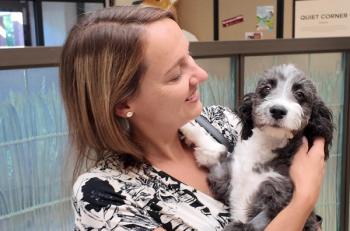
A poodle mix pulled from a hoarding case had a minimally invasive procedure for patent ductus arteriosus at Washington State University. The veterinary pathologist who fostered him then adopted him.
Heart murmurs in dogs and cats often require more than monitoring, according Tripp Oliphant, DVM, who recommends earlier echocardiography and cardiology referral, as murmur grade may not reflect true cardiac disease severity.
Many heart murmurs warrant more than continued monitoring, according to Tripp Oliphant, DVM. A small animal veterinarian who practices urgent care and emergency medicine, Oliphant discusses why he recommends referral for echocardiography rather than serial auscultation alone and why murmur grade does not necessarily reflect the extent of underlying heart disease. Drawing from his emergency medicine experience, he explains that many patients presenting in congestive heart failure have had heart murmurs for years without undergoing a comprehensive cardiac workup. Earlier cardiology evaluation, he says, can help identify patients who may benefit from treatment before they require emergency care.
Below is the transcript, which has been lightly edited for clarity.
dvm360: What trends, recurring case presentations, or common misconceptions have you noticed in emergency medicine that veterinarians should be paying closer attention to?
Oliphant: One of my biggest pet peeves—and this was from one of my mentors, she's an amazing cardiologist who I think so highly of—she taught me never to monitor a heart murmur. I think that there is this thing—it's getting better—but there was an older set of thinking that we are going to monitor a heart murmur. Unfortunately, I always tell the technicians, what are we monitoring for? We can't necessarily listen to a murmur—yes, we can grade it—but we can't say the extent of cardiac disease without truly having an echocardiogram with a cardiologist.
Usually what I tell owners is—I never am going to talk poorly about the referring practitioner—but I'm like, "Okay, well, your dog, I hear today it does have a heart murmur."
And they're like, "Oh yeah, they said to monitor."
At that point, I'm just going to say, "Well, I would recommend getting this seen by a cardiologist."
The reason I say that is the trends that I've seen are there's a lot of cases that will come in that are in congestive heart failure, and they've been having a murmur for 3, 4, 5 years. A lot of times it's cats, and [owners] are coming in and they are like, "Oh, yeah, well, we are monitoring the heart murmur."
In my opinion, and also what I've been taught by the cardiologist, is we can get these cats and dogs on medications that hopefully are going to prolong their life, and we're not having to put them on oxygen therapy. So that's one of the biggest things that I see come through the ER, which, I don't mind managing them, but it's just something that I've seen.