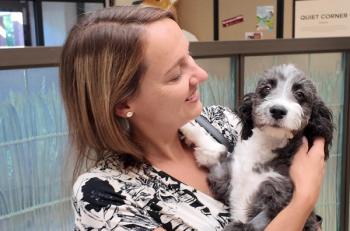
A poodle mix pulled from a hoarding case had a minimally invasive procedure for patent ductus arteriosus at Washington State University. The veterinary pathologist who fostered him then adopted him.
By automating measurements used to track heart enlargement, RadAnalyzer could help veterinarians detect changes in canine heart disease and make more informed treatment decisions.
Researchers at Texas A&M University's College of Veterinary Medicine and Biomedical Sciences have found that an artificial intelligence (AI) tool can measure heart size on dog chest x-rays about as accurately as trained veterinarians, according to a study recently published in PLOS One.1
The tool, called RadAnalyzer, which originated as a student prototype developed through Texas A&M's Aggies Invent program, is a web- and smartphone-based application that automatically calculates 2 standard measurements veterinarians use to track heart enlargement: vertebral heart size and vertebral left atrial size. These measurements help determine whether a dog's heart is changing over time and whether treatment should begin.
Chest radiographs are commonly used to monitor heart disease because they are more affordable and more widely available than echocardiography, which remains the gold standard for cardiac evaluation but requires specialized equipment not found in every clinic. However, manually measuring heart size on a radiograph requires identifying anatomical landmarks, placing markers, and calculating values by hand—a process that can vary from one clinician to the next.
Using more than 1000 canine radiographs, the researchers compared RadAnalyzer's measurements with those of a highly trained observer and found close agreement between the 2, suggesting the tool can perform at a level comparable to that of experienced specialists.
"Most of the AI we're talking about isn't a black box," said Sonya Gordon, DVSc, DACVIM (Cardiology), the study's principal investigator and a professor in the Department of Small Animal Clinical Sciences at Texas A&M. "It's really a tool that helps people do their jobs better. It doesn't replace us; it helps us.2
The measurements are particularly relevant for monitoring myxomatous mitral valve disease, a condition involving a leaky heart valve that is common in older, small-breed dogs. Many dogs develop heart murmurs well before showing other signs of illness, and tracking chamber enlargement over time helps veterinarians decide when to start treatment.
According to Gordon, those decisions typically fall to primary care veterinarians rather than specialists, as there are only approximately 400 veterinary cardiologists practicing in the US. She said tools that streamline the measurement process could ease that burden because the radiographs are already being taken, and reviewing automated measurements takes less time than performing them manually.
The measurements can help identify when a dog's heart is enlarged enough to benefit from pimobendan, a medication shown to delay the onset of clinical symptoms. Gordon said the drug can extend symptom-free survival by an average of 60%, or more than a year for most dogs, when started at the appropriate time.1
The research team pointed to measurement consistency as one of the tool's key advantages. Prior research from Gordon's group found that variability among clinicians decreases with experience but does not disappear entirely. RadAnalyzer, by contrast, produces the same result each time it evaluates a given image.
"The AI tools have essentially zero measurement variability," Gordon said. "Because they're consistent from one measurement to the next, they may be able to identify disease progression more precisely than humans can."
That consistency could matter most when veterinarians are watching for small changes in heart size over months or years, as a modest increase can signal that treatment should begin.
Gordon said that as AI applications become more common in veterinary medicine, rigorous validation studies will be necessary to confirm that the tools perform as intended. She described the goal of such technology as supporting a veterinarian’s judgment rather than replacing it.
"If people think of AI as something that's making us obsolete, they're looking at it the wrong way," she said. "It's making us better."
References