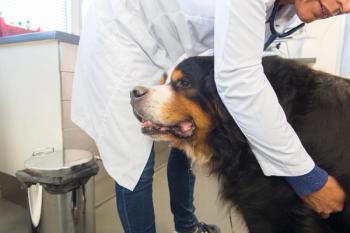
A poodle mix pulled from a hoarding case had a minimally invasive procedure for patent ductus arteriosus at Washington State University. The veterinary pathologist who fostered him then adopted him.
During a recent recording of The Vet Blast Podcast presented by dvm360, Jonathan Goodwin, DVM, MS, DACVIM (Cardiology), and host Adam Christman, DVM, MBA, explain the difference between syncope and seizure and how you can educate and help clients.
Did you listen to last week’s episode of The Vet Blast Podcast presented by dvm360? If not, we have a sneak peek right here just for you!
During the episode, Jonathan Goodwin, DVM, MS, DACVIM (Cardiology), sat down with our host, Adam Christman, DVM, MBA, to discuss the top 5 questions general practitioners ask cardiologists.1 Below, Christman and Goodwin discuss the differences between syncope and seizure, how to explain to clients the difference through analogies, and how to instruct clients on different ways they can help their pet at home.
The following has been edited lightly for clarity.
Adam Christman, DVM, MBA: I think the No. 1 most important question—not most important. There are a lot of great ones, but this is a very common question that we get asked: Is it a seizure, or is it syncope? So talk to us about that.
Jonathan Goodwin, DVM, MS, DACVIM (Cardiology): That’s a good one. It's really tough because the problem is [that] owners don't know the word “syncope,” so everything [has to] be a seizure. Like, “Oh, doc, he had something that looked like a seizure.” And if we're not careful, [we’re] busy, [and] we're flying around trying to do everything all at the same time, you're just going to take what they said: “OK, the dog had a seizure. Here's some Keppra [levetiracetam] today.” The problem is [that] they don't know what syncope is, [so] they don't even know it's an option. So what's really the difference?
I tell people it's kind of like when you're working on one of those old computers, and you’re typing, and your power goes out, but it comes right back on. You're like, “I didn't lose any of my work. It's all right here because I didn't save it yet.” …That's more like syncope, like a brownout where [a] seizure is. You're working on that computer, someone unplugs it, [and] you plug it back in fast, but now you [have] to reboot safe mode. You lost all your work. You [have] to restart. With syncope, it's a quick drop in our blood pressure. That quick drop in blood pressure doesn't let good blood get to the brain. [With] no good brain blood flow [and] a little disconnect, the animals will often fall over, vocalize, [and] sometimes pee or poop. They usually get that apostolic-type shape, where they'll stretch out and get real stiff, like a fainting goat, but they usually are back to…completely normal within 10 minutes or less.
You talk to the people, [and] they'll always say it's longer. Honestly, it's probably like 2 minutes or less, but it feels like forever because of the terror. When we have that, the key with the syncope is [that] those guys are almost always—I'd say 95% of the time—triggered events. They tend to happen with things that cause a drop in blood pressure, [such as] coughing, peeing, pooping, vomiting, being asleep, [or] when they first get up [and have] that orthostatic hypotension. Those are the things that set you up for sinkable episodes. The key is…when they tell you, “OK, this all happened.” They want to talk to you about what they saw. Ask them what happened in the 2 to 3 minutes just prior to the episode. “Oh, he went out to pee…and he was running back in the house and fell over.” So the peeing probably dropped the pressure. The dog didn't sit back down and relax after the pressure drop, tried to run up the stairs, [and] went down. Or the cat [goes] in the litter box, comes out, vomits, and then passes out. All that's high vagal tone….
RELATED:
Christman: I'm thinking [about]…the number of years you have done this. You must have described that and done that thousands of times.
Goodwin: My brother, I get more love from clients when…I could tell them the perfect physiology of why the cough irritates the pharyngeal region and affects your vocal cords. And they're like, “Oh, OK.” But if I do their cough, they're like, “This guy knows what he's talking about.” I just try to…make it easy for [them].
Christman: It's really helpful. My oldest—she's no longer with us—but Chelsea had congestive heart failure, and she would go up the ramp and…have exercise-induced syncope. My question to you is: Is it worth teaching our pet owners about oxygenation? Does it help for at-home therapy when they bounce back from something?
Goodwin: Really good question. If they have something underlying like pulmonary hypertension, 1000%. Oxygen therapy at home would even be wonderful. I sometimes talk to owners about setting up a fan, just a big floor fan, [and] leave it on all the time. If the dogs feel like they're not getting good air, they will go and put themselves right in front of that fan, just like they do in the car. When you turn on the vent, they'll put their nose right [there]. That air blowing in their face makes them feel like they can breathe better.
Christman: I don't know if you've heard of the company Pawprint Oxygen, but I got them some of their bottles—or whatever you want to call the canisters, I should say—and I like the way that the masks were especially for dachshunds, because [of their] dolichocephalic nose. It really did help her bounce back nicely and calmly…. I got to bring her into the hospital, get her stabilized…and it helps.
I was always curious to see, and I've heard around the country, that [giving] some supplemental oxygen helps, not for all cases, of course, but for some…because [they want] to do something at home.
Goodwin: They really do. Everybody loves their babies. It's hard to see them go through some things like that.
Christman: It's awful.
You can listen to the rest of the conversation
References