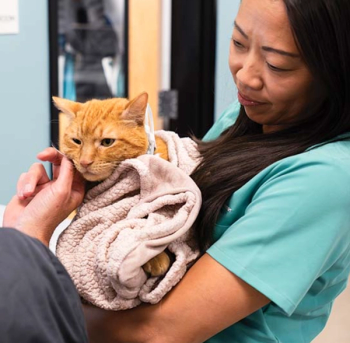
Could our profession's growing emphasis on empathy be contributing to defensive medicine, compromised clinical judgement, and veterinary burnout?
Correct answer for Image Quiz: Cytology-A dyspneic calico with a runny nose
Mycobacterium species infection is correct!
The sample contains a mixture of inflammatory cells, including neutrophils, lymphocytes, and some large epithelioid macrophages. These macrophages have abundant pale-blue cytoplasm lacking the vacuoles we so often find in macrophages. The lack of vacuolization makes these cells more difficult to recognize as macrophages, but the presence of the other cells helps you identify this as a chronic inflammatory reaction. The macrophages all contain white linear structures (bacterial rods) in their cytoplasm, and similar structures can be can be seen free in the background between the cells. This negative staining is characteristic of Mycobacterium species and is unique to this family of bacteria. Their lipid-containing cell walls will not stain with Romanowsky or Gram's stains, but will have positive acid-fast results. Culture with or without PCR testing is needed for speciation, but the ubiquitous saprophytic Mycobacterium avium-intracellulare complex (MAC) organisms are often the cause of opportunistic infection in cats, especially ones that are immunosuppressed by feline leukemia virus or feline immunodeficiency virus infection. Immunosuppressed owners should be advised to not keep a cat infected with Mycobacterium species, but owners may also acquire infections from environmental sources such as the biofilms that coat the internal surfaces of water pipes, fixtures, and storage tanks.