A new cost analysis finds that matching relapsed lymphoma treatment to a personalized drug-response test was associated with longer disease control and a lower estimated daily treatment cost in dogs.
In an interview with dvm360 at the 2026 Fetch National Harbor Veterinary Conference, a veterinary oncologist and a veterinary social worker explained how the role supports owners and staff through a difficult patient diagnosis, treatment, and end-of-life care.
A pet's diagnosis of a serious or chronic illness can create challenges that extend beyond the medical care itself. Owners may face difficult treatment decisions, caregiver stress, financial concerns, and anticipatory grief, and veterinary teams must balance those needs with the clinical demands of the case.
Veterinary social workers can help bridge that gap by providing support to clients and veterinary professionals during emotionally difficult cases. Their role can include helping owners navigate a diagnosis, assessing psychosocial needs, facilitating communication with the medical team, and supporting staff through challenging cases.
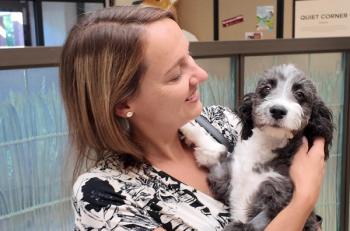
At the 2026 Fetch National Harbor Veterinary Conference, in Maryland, earlier this year, dvm360 spoke with Erika Krick, VMD, DACVIM (Oncology), specialty medical director at Mount Laurel Animal Hospital, and Caroline Cox, LSW, MSW, the hospital's veterinary social worker, following their session, "Collaborative Oncology Care: Leveraging Veterinary Social Work for Comprehensive Support." They discussed how veterinary social work can support clients and teams throughout serious and chronic illness, including cancer, from diagnosis and treatment through end-of-life care.
Here are 8 ways Krick and Cox said veterinary social workers can support a veterinary practice, its clients, and its team.
A veterinary social worker meets the "human needs" of veterinary medicine. For clients, that can mean help with difficult decisions, coping with an emergency, a pet's chronic illness, or end-of-life care. For the veterinary team, it can mean case debriefing, education on compassion fatigue, and support for staff well-being during hard cases. It is a framework Krick and Cox returned to throughout the interview.
One of the clearest ideas in the conversation is the division of labor: the medical team keeps working the clinical side of a case while the social worker supports the client. Krick told dvm360 that having Cox step in gives the team room to reassess the medicine while the client still gets the human support they need. The veterinary team handles the medical care; the veterinary social worker supports the client.
Cox watches for cues that a client may need more support than the medical conversation can give. Examples include a client who says, "I just don't know what to do," who struggles to move forward after getting information, who expresses guilt ("I don't know if I can do this"), or who says something that raises concern, like "this pet is all I have" or "I can't lose them." Cox framed these as the team's cue to bring in a social worker, who asks, listens, and assesses rather than assuming what the client feels.
Clients may communicate distress in ways that extend beyond their words. Cox told dvm360 that she pays attention to a client's tone, body language, repeated questions, difficulty making a decision, and expressions of guilt or fear, while also considering what the client says directly. These cues do not necessarily indicate a specific emotional response, she cautioned, and veterinary teams should avoid assuming what a client is feeling. Instead, they can use those observations as an opportunity to check in with the client and better understand what support they may need.
Krick pointed to research showing caregiver burden in owners of pets with cancer can begin at diagnosis, well before the shift to end-of-life care. She noted that owners may feel isolated, since people outside the household don't always recognize that caring for a pet with a chronic illness can carry the same kind of caregiver burden as caring for a person.
Behind the scenes, the veterinary team, social worker, and client pass information back and forth. The veterinary team gives the client medical information and options; the social worker reads back to the team what the client actually understands and needs. That lets the two sides sort out two different questions, "what is the client understanding?" and "what needs medical clarification?" If the client is unclear about part of the medical information, the social worker can identify where they need more clarification, allowing Krick and the veterinary team to revisit the information and explain it in a different way.
Krick and Cox suggested offering client resources early in a chronic disease process, alongside educational handouts, and as a routine part of care, without implying something is "wrong" with the client. Making those resources available to all clients in similar situations, they noted, can help avoid singling out clients who may be struggling and make support feel like a routine part of care.
Krick and Cox closed by noting the role is flexible. Depending on the practice, a social worker's time might go mostly to clients, mostly to staff, or into training, case debriefing, and building out resources. The shape of the role can be tailored to what a given practice needs.