Sea You at Fetch Long Beach
|Articles|November 10, 2009

The brain's secret to our success

Our brain helps us learn through success, not failure.

Untitled Document

The saying that you learn more from failure than success does not hold water, at least according to brain chemistry. A recent study, as reported in an article in Science Daily, has shown that neurons register when we perform a task correctly and alter themselves so that we subsequently perform that task correctly, essentially helping us to learn. However, if we perform a task incorrectly, our brain cells don't change, so we don't learn. This result was discovered through an experiment in monkeys and published in the July 30 issue of Neuron.

In the study, monkeys were shown two different pictures—one that meant they were supposed to look right, and one that meant they were supposed to look left. If they looked in the correct direction, the monkeys were rewarded. The researchers studied their brain activity during the exercise and discovered that the brain cells reacted strongly for several seconds when a monkey looked in the correct direction and were rewarded, helping the monkey perform better during subsequent turns. The brain did not react as strongly if the monkey looked in the wrong direction and had no effect on future performance of the task.

This research should help us better understand how we learn as well as how to help people with learning disorders, according to the study's authors.



Related to this article

Q&A: Caregiver burden can begin early in pet illness. Are veterinary teams equipped to support clients, and how can veterinary social workers help both parties?
Caroline Cox, LSW, MSW, and Erika Krick, VMD, DACVIM (Oncology), discuss the role of veterinary social workers in supporting clients, communicating with veterinary teams, and helping practices address the human side of veterinary care in this Q&A from an interview at the 2026 Fetch National Harbor Veterinary Conference.
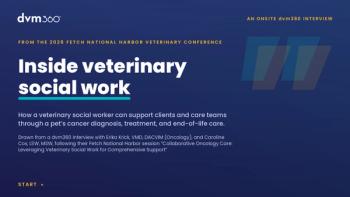
Inside veterinary social work
In a slideshow drawn from an on-site dvm360 interview at the 2026 Fetch National Harbor Veterinary Conference, a veterinary oncologist and a veterinary social worker walk through how the role supports owners and staff across a pet's cancer diagnosis, treatment, and end-of-life care.