

CVC educator Caitlin DeWilde, DVM, lays out social media and website needs for the beginner, the journeyman and the advanced veterinary practice manager or owner.
CVC educator Caitlin DeWilde, DVM, lays out social media and website needs for the beginner, the journeyman and the advanced veterinary practice manager or owner.
Caryn Ginsberg, MBA, strategic visualyst at Priority Ventures Group in Arlington, Virginia, talks about her experiences bringing impact measurement and methods of tracking it to those in the animal protection field.
Mike Dicks, PhD, director of veterinary economics for the American Veterinary Medical Association, describes two risks pet owners are trying to manage when deciding whether to buy pet health insurance.

Adam Parascandola, director of animal protection and crisis response for Humane Society International, explains that there is knowledge among shelter veterinarians about the role that stress plays in illness for animals, but in the general veterinary community that knowledge is not as widespread.
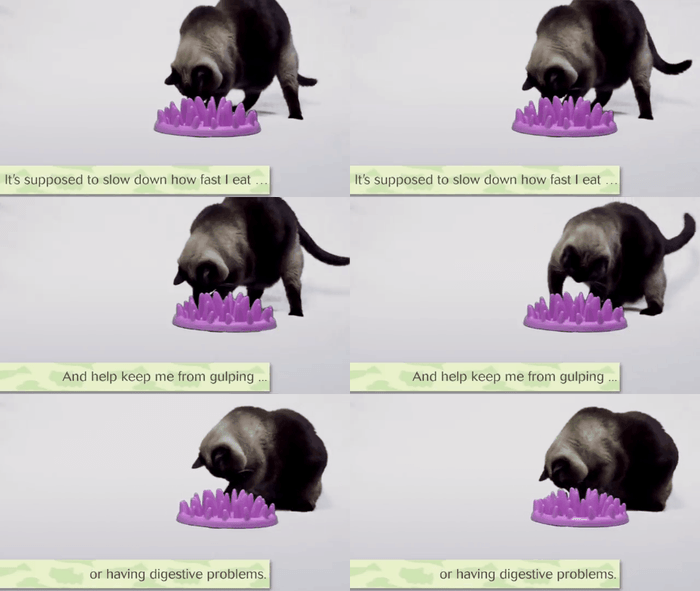
I spent $82.87 on cat food puzzles. Here's what I learned.
Dr. Chen Gilor illuminates two common mistakes you may be making when diagnosing this common endocrine disease.
Sara L. Bennett, DVM, MS, DACVB, owner of Veterinary Behavior Consultations in Fort Branch, Indiana, describes the several different options there are when it comes to medication for noise aversion in dogs.
Amanda Landis-Hanna, DVM, veterinary industry liaison, speaker, and consultant, discusses Purina’s new diet, which is specifically designed to help control neurology issues such as seizures and epilepsy in dogs.
Sara L. Bennett, DVM, MS, DACVB, owner of Veterinary Behavior Consultations in Fort Branch, Indiana, explains how setting up a treatment plan for noise aversion in pets is a 3-step process.
Get your online feline fix in five clips.
Sara L. Bennett, DVM, MS, DACVB, owner of Veterinary Behavior Consultations in Fort Branch, Indiana, says it is OK to pet your dog or cat when they are frightened by a noise event.
CVC educator Dr. Matt Brunke, CCRP, CVPP, CVA, explains why you should consider adding this multifactorial tool to your practice.
The 3 major principles to assist with maintaining doses “As Low As Reasonably Achievable” are time, distance, and shielding. Michael Bailey, DVM, DACVR, project manager for IDEXX, explains what each principle means for veterinary professionals when it comes to reducing radiation exposure.
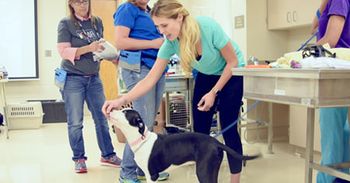
Mikkel Becker shows CVC attendees how to treat to distract for blood draws. (Photo: Ryan Kramer)Nobody likes a needle, not even dogs.
Sara L. Bennett, DVM, MS, DACVB, owner of Veterinary Behavior Consultations in Fort Branch, Indiana, explains that dogs may display signs differently, which makes it hard for owners to recognize anxiety in their pets.

It can be a challenge to explain to cat owners how to give fluids subcutaneously (under the skin) to their cats.
Emily McCobb, DVM, MS, DACVAA, director of shelter medicine in the clinical sciences department at the Cummings School of Veterinary Medicine at Tufts University, says that one of the great things about shelter veterinarians is their ability to come up with a practical treatment plan for patients.
And you have these tools right there in your veterinary clinic, says Dr. Sue Ettinger.
Amanda Landis-Hanna, DVM, veterinary industry liaison, speaker, and consultant, discusses pain management drug Onsior, which provides safe, effective soft tissue surgery postoperative pain relief for cats and, just recently, dogs.

Although it's uncommon, you'll sometimes see a cat with signs of otitis externa. Use these practical tips so you're not fighting the allergies forever.
Ron Ofri, DVM, PhD, DECVO, professor of veterinary ophthalmology at the Hebrew University of Jerusalem, explains how different regions in the world have prevalent diseases based on what’s endemic in that specific area, as well as their geographical location.

Cats can get reobstructed due to ongoing inflammation or trauma from initial treatment, or other problems that may stem from a poor evaluation of the cat. Susan Little, DVM, DABVP (Feline), owner of Bytown Cat Hospital in Ontario, Canada, explains that if veterinarians aren’t careful, they can become a part of the problem.
Amanda Landis-Hanna, DVM, veterinary industry liaison, speaker, and consultant, talks about Galliprant, a molecule developed by Aratana that helps control pain and inflammation associated with osteoarthritis in dogs.
The farther you get away from a radiation source, the better. Michael Bailey, DVM, DACVR, project manager for IDEXX, expresses that if you’re wearing the proper gear, you can hold onto a pet getting a radiograph, but if you’re not holding onto the pet you should leave the exam room.
Susan Little, DVM, DABVP (Feline), owner of Bytown Cat Hospital in Ontario, Canada, says about one third of previously obstructed cats are likely to reobstruct in the future.
More than 1.2 million dogs every year are reported to have cranial cruciate disease. Amanda Landis-Hanna, DVM, veterinary industry liaison, speaker, and consultant, explains how a lot of things that veterinarians believe about this common disease are not always true.
CVC educator Wayne Usiak, AIA, shares his frustrations with clientsnot YOU, is it?

The hardest question you have to face as a pet owner. Dr. Mary Gardner wants to help your veterinary patients have a perfect ending to their perfect life.
Heather Wilson-Robles, DVM, DACVIM (Oncology), associate professor in the veterinary medicine and biomedical sciences department at Texas A&M University, discusses some of the limitations and challenges that she believes comparative oncology faces.
Ellen Lindell, VMD, DACVB, owner of Veterinary Behavior Consultations in Bethel, Connecticut, says veterinarians should consider how much impact they have on patients during exams—especially young patients.