The first survey of parasite control on bison ranches shows most herds are dewormed on a schedule, with little testing to see whether they need it. Researchers say the habit could make resistance harder to manage.
Christopher Lee, DVM, explains Toxoplasma gondii facts: why most indoor cats rarely shed, plus pregnancy-safe litter tips for cat health
On a warm Saturday morning, a tall, blond man walked into my hospital with 2 cats for euthanasia. Hint number 1: 2 cats. They were apparently healthy Russian Blue cats named Molly and Pixiebell, 12 and 14 years old, respectively.
He wanted to euthanize both cats because his wife was pregnant. He had read about a parasite that could cause miscarriage, and he did not want to take any chances. When I suggested that he handle litter box duties during the pregnancy, he responded that he doesn’t do that. When I offered to help adopt the cats out, he stated that Molly and Pixiebell could not stand to live in a world without him. I began wondering if CPS worked with fetuses.
After exhausting several other options, we reached an impasse. Unable to adopt the cats out, we refunded his money and asked him not to return to our hospital. While extreme, this sadly true story reflects many anxious conversations between veterinary professionals and the public.
To begin with, Toxoplasma gondii (T. gondii) is a single-celled apicomplexan protozoan and an obligate intracellular parasite. The definitive hosts are felids, and the intermediate hosts are, well, almost everyone else. Although cattle show some resistance to infection, almost every warm-blooded animal can be infected. Furthermore, it is one of the few parasites that can be found in virtually any tissue of almost any warm-blooded species.1 Chronic infections are often clinically silent, but tissue cysts may persist for life. Yikes!
To make matters worse, beyond abortion in ruminants and miscarriage in humans, T. gondii can generate a wide range of clinical signs, including neurologic disease. Based partly on documented brain and behavioral changes in infected mice, numerous human studies have reported associations with schizophrenia, altered cognition, and other neuropsychiatric conditions. Those associations remain correlative; causation has not been established.2 Still, scary.
Since felids are the definitive hosts of this parasite, cats are responsible for environmental contamination with T. gondii oocysts. Without getting into the weeds, oocysts are the apicomplexan protozoan equivalent of an egg. They are shed unsporulated and must mature in the environment before becoming infectious. Under the right conditions, sporulated oocysts can remain infective for four and a half years.3
When a cat is shedding T. gondii oocysts in its feces, it does not dabble. Published estimates suggest that a cat may release 2 million to 20 million oocysts per day during active shedding. At the upper estimate, 2 weeks of shedding could theoretically add 280 million oocysts to the environment. A lot of cats, a lot of poop, a globe covered with long-lasting, stable T. gondii oocysts.4
Combine this with long-term or permanent infection, the causal link with human miscarriage, and the theorized schizophrenia and memory loss, and you may be starting to side with Molly and Pixiebell’s dad.
Not so fast.
If there is a silver lining to lifelong infection, it is that there is a time before and a time after initial exposure. Let’s walk through this. Until a cat is infected with T. gondii, there is no oocyst to make. When the cat becomes infected, this protozoan sexually reproduces in the intestinal epithelium and creates oocysts for roughly 1 to 3 weeks.5,6 Yes, read that again: roughly 1 to 3 weeks. Some cats live 20 years, and Crème Puff of Austin, Texas, lived for an astonishing 38 years and 3 days.7 Even if a cat sheds for the full 3-week upper end of the usual range, primary shedding occupies only about 0.29% of a 20-year life. In other words, that cat typically spends more than 99.7% of its life not shedding T. gondii oocysts.
Most cats do not shed oocysts again, although repeat shedding has been documented experimentally after later re-exposure.8 How frequently this occurs in ordinary household cats is not well quantified. Exposure, initial or later, may come from eating infected tissues or ingesting sporulated oocysts. Many cats will live the rest of their lives without shedding oocysts again.
A similar before-and-after pattern applies to humans. Typically, prior infection protects a person from becoming infected again. There are always outliers, however, and rare cases of reinfection with T. gondii have been documented.9 Remember, humans, like other non-feline mammals, are intermediate hosts. We do not shed oocysts; instead, the parasite may persist for life as tissue cysts, particularly in neural and muscle tissues.
Thus, in the usual primary-shedding scenario, for Molly or Pixiebell to transmit T. gondii to their owner and contribute to a miscarriage, a series of steps must align:
When compared with undercooked meat, contaminated produce, soil exposure, and inadequate hand hygiene, the risk posed by a healthy, mature indoor cat eating commercial food is comparatively limited.10 That does not make every cat-associated exposure irrelevant: young cats, hunting cats, raw-fed cats, and direct contact with contaminated feces deserve greater attention.
So why do we always talk about the cat-litter box-miscarriage connection?
Well, it can and does happen. But if the risk is comparatively low, why is this the guiding message? First, it is a sticky message, meaning it is simple and easy to remember: cat-litter box-miscarriage. The less memorable reality is that parasitic oocysts are one more reason to wash fruits and vegetables, cook meat properly, take precautions while gardening, and wash your hands.
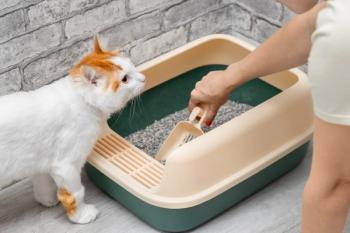
What do we do with all of this information? The key is not to ignore the cat litter box risk but to place it firmly in proper perspective. For pet parents trying to become pregnant or who are expecting, several practical solutions are available. The standard advice remains education about the life cycle and having someone other than the pregnant person clean the litter box. When no one else can do it, cleaning it daily while wearing disposable gloves and washing hands afterward keeps the risk low because oocysts need 1 to 5 days, commonly 48 to 72 hours, in the environment to become infectious.11
Antibody testing can add context for both the person and the cat. Positive IgG results in people typically indicate previous infection and substantial acquired protection. This greatly reduces the likelihood of reinfection but does not turn the result into an ironclad guarantee. Most infected people never develop clinical disease. During pregnancy, human serology requires medical interpretation because IgG alone does not establish when infection occurred.12 The reported associations with schizophrenia and memory loss remain correlative, not causal.
Positive IgG results in cats support previous infection, and most seropositive cats have already completed their primary shedding period. They are therefore unlikely to be shedding or to shed again. Serology shifts the probability; it cannot determine with certainty whether an individual cat is shedding at that moment.13 Immunosuppression can reactivate latent tissue infection, but reactivation of clinical toxoplasmosis is not synonymous with renewed oocyst shedding.
For anyone in the medical field, we know that these tests are not absolute. To eliminate every theoretical risk from a household cat shedding oocysts, Molly and Pixiebell’s dad had the right idea. Euthanize all household cats, and while you’re at it, eat no raw fruits, raw vegetables or salads, don’t even touch a vegetable. Have no meat prepared in the house, never touch a potted plant, and do no gardening. Self-contained Eco Pods and dehydrated food systems are available.
For the rest of us, take sensible precautions, live life, and embrace parenthood. Proper precautions include thoroughly washing fruits and vegetables, properly cooking meat, using gloves when gardening, and frequent handwashing. To address the lower risk from the typical household cat, pregnant women should avoid cleaning the litter box, which will be training wheels for dad when it comes to diapers anyway.
Perhaps the best summary of T. gondii risk reduction is also the simplest: clean hands, healthier futures.
References