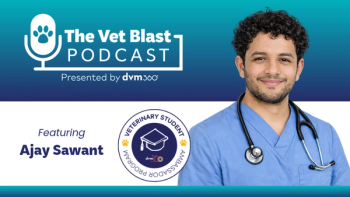
dvm360 Student Ambassador Ajay Sawant discusses the connections between animals, ecosystems, and veterinary medicine.
A diplomate of the American College of Veterinary Preventive Medicine shares how board certification bridged the gap between epidemiology theory and real-world practice.
On this episode of Vet Watch, host Christopher Lee, DVM, MPH, DACVPM, DACVM (Parasitology), talks with Fortune Sithole, BVSc, MSc, PhD, DACVPM, associate dean for academic affairs and professor at Lincoln Memorial University College of Veterinary Medicine at Orange Park, about the specialty that works quietly in the background to keep animals and people safe. Sithole shares his journey to board certification and why the American College of Veterinary Preventive Medicine (ACVPM) deserves a closer look.
Below is a partial transcript, edited lightly for clarity.
Christopher Lee, DVM, MPH, DACVPM, DACVM (Parasitology): What made you go toward and pursue board certification? You already have a PhD and a master's, so you have all this advanced training in epidemiology. What was that additional value that you were looking for, specifically, to become a diplomate of the ACVPM?
Fortune Sithole, BVSc, MSc, PhD, DACVPM: I always wanted to do these boards, but I did [them] when I was working in the Ministry of Health [in British Columbia, Canada], developing policy in food safety. So suddenly, I'm confronted by situations that require me to know quite a lot about the laws, the concepts of food safety, the concepts of epidemiology, more of the application, per se.
What a PhD gave me was lectures in epidemiology and surveillance. I learned the concepts. And also, my research thesis. So, it was more the academic and research aspects, which are different from the practice aspect.
When I worked for the Ministry of Agriculture in Edmonton, in Canada, I was asked to formulate a policy on how to collect samples if people suspect anthrax. How do you collect a sample? Just that alone took me two months to come up with that protocol. So, it's one thing to learn about the concepts, and another to actually develop practical ways of doing things. That's the kind of knowledge the specialty has given me: the actual practice of preventive medicine. And I really felt that even after my PhD, there was a gap in my knowledge.
So, becoming a diplomate really taught me a lot in the jobs that I had in public practice, but as a teacher, too. I learned so much that has helped me to be an effective teacher of epidemiology and public health.
Lee: Thinking back to 2010, you just passed and became a diplomate. You've just become board certified. What doors did that open? How did that influence your work, confidence, professional relationships? Walk me through what changed.
Sithole: I felt a sense of accomplishment after finishing my boards, even after my PhD. I know that's a function of perception, but that's what the boards meant to me. The accomplishment meant a lot to me.
And the doors it opened: credibility. There are so many people who work in our area who do not have boards, and it doesn't mean that they're not effective at what they do. But for me, I felt empowered, not only in terms of the knowledge that I felt I had after the grueling exams, but also just the credibility. I felt I was more credible with that qualification.
But also, these days, for academic jobs, you do get some universities requiring board certification in preventive medicine to teach public health and epidemiology. A number of universities are demanding that. So, it does open up all kinds of doors.
Lee: It's interesting to hear you say that, just because a PhD is such a huge accomplishment as well. But it sounds like, even though your PhD and your master's gave you a lot of information, maybe this helped fill out gaps, because PhDs are pretty tough. It's not an easy accomplishment to have. But did it maybe give you more breadth as well, as a foundation?
Sithole: Yes, Christopher, you're right. Because you're looking at concepts in epidemiology, but also food safety legislation, occupational health. So, it does give you a broad base, but it also gives you the legislation that underpins all these things. Legislation is how we act on the concepts that we get. So, the PhD gave me concepts in epidemiology and food safety. But the knowledge of the application, as well as the concepts, came from being board certified.
Want to hear more of this conversation? Check out the full episode at the top of this page!