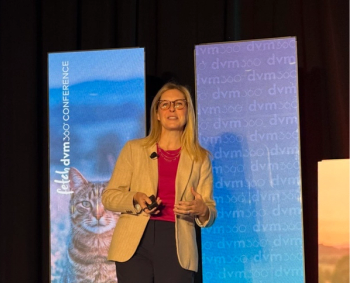
What are the pharmacologic principles for transdermal drug delivery? Joe Smith, DVM, MPS, PhD, DACVIM, DACVCP, cVMA; an associate professor, large animal, for the College of Veterinary Medicine at the University of Tennessee in Knoxville, explains in a dvm360 interview at the 2026 American College of Veterinary Internal Medicine (ACVIM) Forum in Seattle, Washington. Smith, who specializes in farm animal medicine and veterinary clinical pharmacology, discusses these principles in a recent lecture at the 2026 ACVIM Forum. In this video, he talks about the appropriate use of transdermal drugs for different patient species.
The following is a transcript of this video, a portion of the interview:
Joe Smith, DVM, MPS, PhD, DACVIM, DACVCP, cVMA: The transdermal drug delivery is an interesting thing in veterinary medicine, because we have the same formulation of the drug that might be administered to different patients and be absorbed completely different ways. There's some standard principles of drug delivery, which is the size of the molecule, the charge of the molecule, the environment the molecule is dissolved in before it is absorbed, that still play a role there. You know, some drugs will be absorbed directly through the skin, some drugs can be absorbed through the sweat glands and hair follicles of the skin, some will be absorbed more through, like the lipid or the fat components of the skin itself. This is a reason that we think about [it] veterinary medicine, as we have different species.
We might have a drug that's absorbed very well through the skin in one species, but not in others. And in the large animal world, one of the things I think about is our transdermal clinics, and so this is a non-steroidal anti-inflammatory drug that can be used for fever or pain, similar to like Advil or ibuprofen, would be in a person. And if we look at cattle, because the nature of their skin, it's not quite as thick. If we look at the specific layers, it has a different blood flow to it. It's fairly well absorbed. About half of what we put on the skin of a cow will make it into the systemic circulation of the cow. Whereas if we look at pigs, which are a little bit thicker, and they have a little bit different composition of their skin and different blood flow, only about 2% of what we apply to the skin gets through there.
These species-specific differences kind of fascinate me. Because in large animal medicine, we're often looking at what our human or small animal counterparts are doing, and we're seeing these drug formulations increase, and their utility, as well as the different applications for it. There's transdermal drugs that can stimulate appetite, there's some that can be used for local inflammation or pain, there's some that can be used for systemic inflammation or pain.
RELATED VIDEO: Understanding standard vs alternative drug delivery