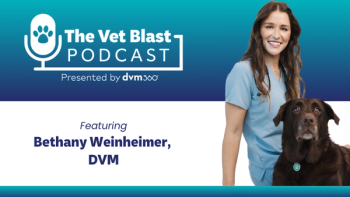
Bethany Weinheimer, DVM, discusses authentic values, the power of “no,” and building a veterinary career that lasts.
Paul Alves, a member of the inaugural class at Rowan University’s Shreiber School of Veterinary Medicine, breaks down the school’s block-based curriculum, its teaching hospital, and the community engagement club.
Editor’s note: This podcast was recorded when Alves was still a first-year veterinary student.
New Jersey’s first veterinary school is a year into teaching its inaugural class, and the students in that class are building the curriculum’s traditions, clubs, and culture as they go.
Paul Alves, now a second-year veterinary student at Rowan University’s Shreiber School of Veterinary Medicine and a dvm360 student ambassador, joined host Adam Christman, DVM, MBA, for this episode of The Vet Blast Podcast. Alves described the volunteer experience that turned him toward veterinary medicine, walked through Rowan’s body-system blocks and integrated exams, detailed which services have opened so far at the school’s veterinary teaching hospital, and explained why the community engagement club he presides over treats social media as a communication skill worth teaching.
Below is a partial transcript, edited lightly for clarity.
Adam Christman, DVM, MBA: You’re also a student ambassador with us here at dvm360, which is awesome, and you’re passionate about the human-animal bond [and] community engagement, with particular interests in small-animal general practice, ophthalmology, and internal medicine. So my first question to ask you, Paul, is: When did you know you wanted to be a veterinarian?
Paul Alves: Like most of us say, I always knew I wanted to be a veterinarian. I’ve always loved animals, and I always made sure that I had some sort of pet. If I [weren’t] home with my animal, I would have a stuffed animal with me. But it wasn’t until late high school that I decided I was going to go full-on with the vet thing. I had actually volunteered at a human hospital because I knew I liked medicine, I liked helping people, and I’ve always been interested in medical care. I volunteered at a hospital for about 3 months, and then COVID-19 hit. But I knew it was not for me. There was just some disconnect there, and I couldn’t fully understand it.
But after COVID-19, I had volunteered at a vet hospital, and they eventually hired me, which was amazing. I knew immediately that’s where I wanted to be. And not only do I love animals, but I [also] really love the client bond you form. I think that people are very vulnerable and genuine when it comes to their animals, and you see them in a state that you might not see them in anywhere else. That’s what I really love about veterinary medicine, because you can work with animals in other careers, and those careers are amazing, but the people-to-people connection that you get in vet med is unlike any other.
Adam Christman, DVM, MBA: What does that feel like to you, knowing that there’s finally a vet school in New Jersey?
Paul Alves: It still feels surreal, and it’s starting to feel more real now because we have our Admitted Student Day tomorrow, so we’re welcoming our next class. But it’s felt kind of unreal this whole time—the fact that I grew up in North Jersey, I was able to go undergrad in Central Jersey, and now I go to vet school in South Jersey.
Adam Christman, DVM, MBA: Where’d you go to undergrad?
Paul Alves: Rutgers, so I’ve been able to pay in-state tuition my whole academic career, which is amazing. And I had always seen the news articles about Rowan…opening up, but I was always super skeptical about it, and I did not really even consider that I’d be able to attend Rowan until a couple of months into my application cycle. That’s when I really thought [that] this could actually be a reality for me.
Adam Christman, DVM, MBA: Tell me a little about the program at Rowan. Share with the listeners what that’s like.
Paul Alves: Our curriculum mirrors a lot of other vet schools…. We do all normal in our first year—we just learn the normal, the healthy—and then we learn…the diseases in our second year. So we just reinforce our initial knowledge and add on the disease processes and all that. We do our exams in a unique way, I think, compared [with] other vet schools, where we sometimes will have an exam every other week, but they’re compiled. So we’ll have 5% of it on histology, 20% of it on physiology. It’s all based on lecture hours. So rather than having individual exams for physiology [and] histology, we have them compiled, so we’re still studying the same amount of information. It’s just how many questions we’re actually getting tested on. But it allows us to take fewer actual exams, which gives us more time to do classes, to study, and it gives us more time to have free time. And I really, really love that.
Want to hear the rest of the conversation? You can listen here or wherever you listen to podcasts.