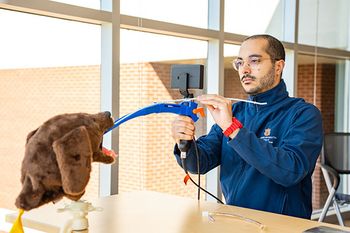
Veterinary and engineering students at Auburn University worked through several prototypes and campus visits to build a 3D-printed laryngoscope for teaching intubation in goats and pigs.
A pain management protocol is only as good as the conversation behind it.
Client-pet bond, client-veterinarian bond, and communication are the key contributors to client compliance for both diagnostic workup and management of their pet’s condition(s).1 Clients rely on us to guide them in the right direction for diagnosis and therapeutic management of pain in their pet. It’s why they come to us. When that conversation is rushed, or the client leaves not feeling their questions were answered, even a well-constructed multimodal plan can quickly and quietly fail.
Both the 2022 American Animal Hospital Association (AAHA) Pain Management Guidelines for Dogs and Cats and the 2022 World Small Animal Veterinary Association global pain management guidelines emphasize proactive, preemptive analgesia over a reactive approach.2,3 The same philosophy should equally apply to communication around potential or anticipated pain. Rather than waiting for a client to express concern over their pet’s anticipated pain or express that their pet seems in pain, the clinician should proactively communicate what pain may be anticipated, what is or will be done to control the pain and what success should look like.
How management of analgesia is framed also matters. When presenting a multimodal approach, explain the why and pose it as a standard component of care, rather than an optional upgrade. This communication is a primary indicator of compliance.1
Identification of pain can be subtle. Starting with asking clients whether they feel their pet is in pain or asking them to rate their pet’s pain on a scale of 1-5 is a good way to understand what the client’s perceptions are. Chronic pain in dogs and cats often surfaces gradually: no longer climbing to the top of the cat tree, reluctance to go up/down stairs, altered grooming, irritability, more/less interaction, decreased appetite, etc. Many clients attribute these signs to “normal” aging, rather than pain or discomfort. This often delays the client/veterinarian discussion and thus delays diagnosis and early management.
During annual visits, discussions, even early in life, should incorporate questions such as “Is Fluffy still doing all the things he/she enjoyed doing last year?” “Does he/she seem to be eating as well as usual? If not, where are you feeding him/her?” The loss of normal behaviors may be a more important indicator that further assessment is warranted.
AAHA emphasizes that owner input is especially valuable in recognizing chronic pain, tracking progression and gauging response to treatment.2 The Canine Brief Pain Inventory asks clients to score pain severity and its interference with everyday function, and helps to evaluate treatment response.4 While the Feline Grimace Scale is validated for acute pain scoring, it can be a useful tool for client at-home assessment as well. This system scores 5 facial characteristics, is quick and easy to do, and has demonstrated good inter-rater reliability.5 The use of these tools not only involves the client in the process, which they often appreciate, but it also provides structured and validated data, converting subjective to objective conclusions.
Open-ended questions allow clients to describe what’s happening at home in their own words, capturing a fuller picture and richer diagnostic information than closed or yes/no questions. Confirming what you heard also ensures that the client feels fully heard and that you have the right baseline information. After discussing your plan and any potential side effects of new medications, it is also important to ask what is still unclear and what questions they have before the visit ends.
Clients often are hoping for or looking for the simplest solution and a quick resolution to their pet’s medical needs. As we all know, pain management is complex and often needs management from more than one modality. Providing this context, explaining simplified pain pathways and contributors to pain, as well as discussing the why beyond multimodal pain management, is key to client compliance and best patient care. This does not mean that every potential pain management drug, supplement or modality needs to be instituted day one, but may be more of an evolving plan, based on the patient’s response to care.
Be transparent that there are many care options and that you may need to change course early on or throughout management, and that this is normal. It is also important to set clients up for the anticipation of recheck appointments, either in person or virtually, to ensure you know if that course needs to be modified. Forward booking that appointment before they leave helps ensure compliance and follow-up care.
References