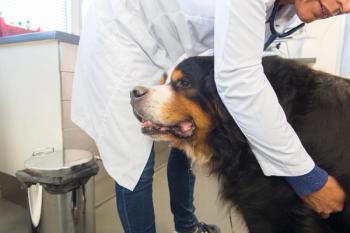
A poodle mix pulled from a hoarding case had a minimally invasive procedure for patent ductus arteriosus at Washington State University. The veterinary pathologist who fostered him then adopted him.

Brian A. Scansen, DVM, MS, DACVIM (Cardiology), traced degenerative mitral valve disease from the at-risk patient to refractory failure and outlined the radiographic thresholds that determine who starts therapy.
Myxomatous mitral valve disease is the most common heart disease in dogs, but the moment a primary care veterinarian first hears a murmur is still one of the hardest conversations in the exam room. That gap between detection and next steps framed the opening keynote at the Fetch dvm360 conference in Kansas City, Missouri, delivered by Brian A. Scansen, DVM, MS, DACVIM (Cardiology), professor and service head of the cardiology and cardiac surgery section and director of the Don Lockton Family Heart Center at Colorado State University.
Titled "The Murmur Matters: Addressing Mitral Valve Disease in Primary Care," the session walked attendees through the decision points that follow a new murmur in an asymptomatic dog: distinguishing benign from pathologic murmurs based on clinical presentation and risk factors, deciding whether radiographs are sufficient or an echocardiogram is warranted, and applying current evidence-based guidelines to staging and the timing of medical management.
Scansen also devoted attention to the client side of the diagnosis—how to explain a murmur, justify the recommended diagnostics, and describe disease progression without sending the pet owner into a panic.
Scansen lectures internationally on the diagnosis and treatment of heart disease in animals. His clinical and research interests include congenital heart disease, advanced cardiac imaging, and novel treatments for structural heart disease.
A full recap of the keynote is coming soon on dvm360.com.