

Additional resources on feline atopic skin syndrome:
News|Videos|April 4, 2025
Creative solutions for feline atopic dermatitis
Sandra Koch, DVM, MS, DACVD, discusses alternative treatment options for feline atopic skin syndrome, commonly referred to as feline atopic dermatitis
Advertisement
Treatment options for feline atopic syndrome (FASS)—also known as environmental allergies or atopic dermatitis—lag behind those for dogs, making management of the condition particularly difficult. As Sandra Koch, DVM, MS, DACVD, professor at the University of Minnesota College of Veterinary Medicine and director of the school’s Veterinary Medical Center Dermatology Service explained in an
Below is a partial transcript, lightly edited for clarity:
Sandra Koch, DVM, MS, DACVD: And then thinking outside of the box, right? Because everything else is either not labeled or we don't have good studies and good evidence of efficacy.
We have to use things like Apoquel, which is labeled for dogs with allergies, but we use [it] in cats. It's not my first choice. Of course, I'm going to have lab work, baseline monitoring like I would for cyclosporine and prednisone, steroids—I should say
The drug doesn't seem to stay effective for too long, so it [has] a short-lived efficacy because of the short life compared to the dogs.
It's a tablet, right, [a] formulation, so not all cats are going to take it, but sometimes I like to tell clients [to] crush [it] and give it in with a treat or something that the [cats] like. And again, we need to monitor closely.
For cyclosporine and Apoquel, the thing we worry about is toxoplasmosis, so we need to make sure that these cats are being screened for [Feline immunodeficiency virus], [Feline leukemia virus], but also toxoplasma with toxoplasma antibody titers. However, even if they're negative—even if they don't have antibodies—it can be concerning, because if they become exposed, it could lead to fatal disease. So, I like to talk to my clients about that. The cats on cyclosporine and Apoquel should not be eating raw meat. They should not be hunting. They should be not outdoors. They should be kept in [the] house. If they're unable to do that, perhaps those medications are not good options for them.
Advertisement
Related to this article

Alyssa Mages, BS, CVT, FVTE, outlines key considerations for veterinary technicians during triage, from rapid patient assessment and prioritization to client communication and team coordination, in this interview from the 2026 Fetch National Harbor Veterinary Conference.

In a session at the 2026 Fetch National Harbor Veterinary Conference, Nathanael Oster, VMD, MBA, walked attendees through the biology, diagnosis, and treatment of the flea tapeworm in dogs and cats, including why cats are affected more often than dogs.

A plethora of continuing-education sessions run across 3 days, September 17–19, at the Gaylord National Resort in National Harbor, MD. Here are the ones to circle first, sorted by practice area, plus a handful that are easy to scroll past and worth catching.
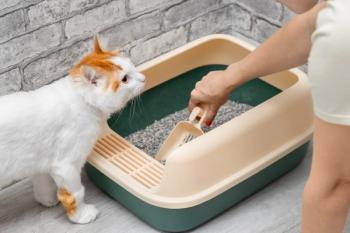
Christopher Lee, DVM, MPH, DACVPM, DACVM (Parasitology), discusses the clinical significance of Toxoplasma gondii, when veterinary professionals should consider testing, and how to communicate the risks of exposure to clients.

Valli Parthasarathy, DVM, PhD, DACVB, discusses how veterinarians can evaluate feather loss, self-mutilation, and vocalization in pet parrots and identify when medical and behavioral factors may overlap.

Caroline Cox, LSW, MSW, and Erika Krick, VMD, DACVIM (Oncology), discuss the role of veterinary social workers in supporting clients, communicating with veterinary teams, and helping practices address the human side of veterinary care in this Q&A from an interview at the 2026 Fetch National Harbor Veterinary Conference.
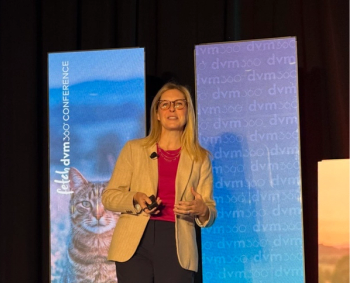
In a keynote address at the 2026 Fetch National Harbor Veterinary Conference, Jessica Pritchard, VMD, MS, DACVIM (SAIM), shared research showing that many owners decline vaccines because they do not think their pet needs them, and discussed ways veterinary teams can address those concerns.
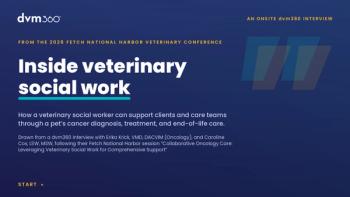
In a slideshow drawn from an on-site dvm360 interview at the 2026 Fetch National Harbor Veterinary Conference, a veterinary oncologist and a veterinary social worker walk through how the role supports owners and staff across a pet's cancer diagnosis, treatment, and end-of-life care.
Advertisement
Advertisement
Trending on dvm360
1
Why pet owners decline vaccines: Survey insights and strategies for navigating hesitancy
2
Recent acquisitions: IDEXX buys CoVet, The Farmer's Dog acquires Woof
3
Paws and profits: Schwarzman AMC names zoological department head, Mars names chief digital and information officer, and more updates
4
Good flea control is good tapeworm control, veterinarian tells Fetch attendees
5