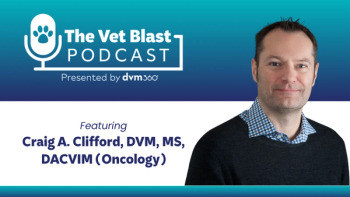
Craig A. Clifford, DVM, MS, DACVIM (Oncology), explains how to recognize feline lymphoma, and covers the newer tools that may help one of oncology's most overlooked patients.
Discover COPAT vs COHAT, normalize full-mouth radiographs, and improve client buy-in insights on this episode of The Vet Blast Podcast presented by dvm360.
On this episode of The Vet Blast Podcast presented by dvm360, Jan Bellows, DVM, DAVDC, DABVP, FAVD, discusses how to elevate veterinary dental care by reframing “dentals” as comprehensive oral prevention, assessment, and treatment (COPAT). He emphasizes shifting client conversations from simple “teeth cleaning” to a prevention-first mindset at every visit, educating owners that halitosis and disease originate in the mouth, not the stomach, and that cleaning is just the first step before assessment and potential treatment.
Throughout the episode, Bellows and our host, Adam Christman, DVM, MBA, continue the conversation by underscoring the critical role of full-mouth intraoral radiographs, given that most of the tooth lies below the gumline in dogs and cats, and suggest building these into wellness plans to normalize annual comprehensive oral care.
Below is a partial transcript, edited lightly for clarity.
Adam Christman, DVM, MBA: The second thing we're talking about is the use and importance of taking full-mouth radiographs, so share with us more about that.
Jan Bellows, DVM, DAVDC, DABVP, FAVD: Understand that…in dogs and cats, 60% of the tooth is below the gumline. In people, only 30% is below the gum line. But in animals, because God put them in there to chase rabbits, squirrels, and hamsters to eat, they put big roots in there. If you're assessing the mouth and treating it with nonanesthetic dentals, or just not addressing the roots, then you're missing so much disease that's there, and your animals are absolutely suffering.
Every animal needs to have full-mouth intraoral radiographs every single time. And…”Oh yeah, great. I'm glad Dr Bellows is recommending that. But how am I going to pull it off?” If you're in a corporate practice or your practice offers a wellness plan, just incorporate it in[to] the wellness plan. Figure out what you normally charge for a professional anesthetic, teeth cleaning, and…full-mouth x-rays, and then cut it into 12 pieces and incorporate that in their monthly fee. Clients will accept it once they see that you really feel that it's important for them, and they will get it at least once a year, complete oral x-rays.
In fact, our office has a CT, and we include the CT in our monthly plan at really no additional charge because we believe in it so much. Even if you discount it fairly heavily, you'll find there is so much disease that you will find with full-mouth x-rays that it will be really easy for the office to profit, if that's your motivation, but so much good care will come out of that…. You have to allot enough time to evaluate them, and you have to allot enough time to treat the amount of dental disease that's there.
Now, once you take full-mouth x-rays on every case, you will be amazed [at] the disease that's there. [Often], the question is: OK, great. I found something. I'm going to have to treat it. How do I get the client to give me approval?” Tell the client that during the procedure, you're going to take radiographs, take a picture of them with your cell phone…text them the image, and…give them a phone call so the clients know what's going to happen later on that day, once you find what's causing the disease. Even if the radiographs are normal but there's an 8-mm pocket you just put the probe in, take a picture of it, and say, “Well, we're going to treat this either by taking out the tooth or using PerioVive, which we're using a lot now, and helping your patient.”
Chritsman: Love that. I'm always surprised [by] what we see. I always call [it] the “iceberg effect”: What's below the surface on those radiographs? Great piece of advice.