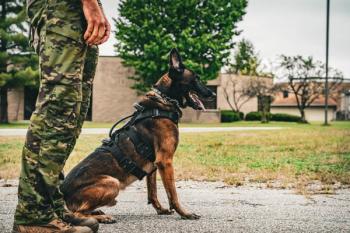
Veterinary care for military working dogs gets an upgrade as a US Army clinic in Germany opens renovated surgical and dental suites that also serve local pets.

When osteoarthritis progresses and quality of life slips, what comes next? A veterinary orthopedic surgeon explains how to recognize the turning point and how joint replacement can help pets move comfortably again.
For many pets, joint replacement is now an outpatient procedure, and that’s only one of the ways the field has changed.
On this episode of the Vet Blast Podcast, Adam Christman, DVM, MBA, talks with Laurent Guiot, DVM, DACVS-SA, DECVS, a founding fellow in joint replacement surgery for the American College of Veterinary Surgeons and orthopedic surgeon at Thrive Pet Healthcare’s ACCESS Bone and Joint Center in Los Angeles. Guiot walks through the path from osteoarthritis (OA)that no longer responds to medical management to surgery, early home care, rehabilitation, and recheck visits, and explains why he calls joint replacement a team sport. He also shares practical points for primary care veterinarians who follow these patients long term.
Below is a partial transcript, edited lightly for clarity.
Adam Christman, DVM, MBA: For a general practitioner managing a dog or a cat with [OA], what are some of the clinical signs or changes at home that tell you that the disease is progressing and quality of life is declining? Not simply that the pet is just what we hear quite often, “slowing down."
Laurent Guiot, DVM, DACVS (SA), DECVS: There is a tremendous variability in clinical expression of those conditions. For the most part, the slowing down is often noticed, but by the time they slow down, they've been suffering from it for a while. There are some differences between dogs and cats as to how they're going to show slowing down.
For dogs, those are dogs that are going to be starting to sit more often. Like when you go on a walk and you pause to talk to somebody on the street, instead of the dog standing next to you, they’re going to start sitting down, or they're going to be less inclined to go for a walk. Sometimes they will point blank refuse to go any further, and those are signs that they're bothering. Some more subtle changes are dogs that become more sedentary—they sit on the couch longer. Sure, with old age, everybody wants to sit on the couch a little longer, but it's challenging to notice if that change is just a little bit of being tired versus pain. On top of it, osteoarthritis often affects multiple limbs. It's not just a one leg problem, and so dogs have a hard time expressing lameness from osteoarthritis. They just show they don't want to walk as much, or run as much, or as fast, or jump as high.
Cats, on the other hand, are completely different creatures. You don't take them on a leash walk for the most part. People tend to report that [their cats] hide a little more. They don't want to jump as much. Sometimes they can even be angry at you if you pet their rear end. So, cats are even more challenging, I'd say, than dogs.
A study not so long ago showed that hip osteoarthritis has a 60% prevalence in cats 10 years and older. We don’t quite realize that, but a lot of them have it. And if it’s anything like what people feel in their hips, cats are suffering.
Want to hear the rest of the conversation? You can listen above or wherever you listen to podcasts.