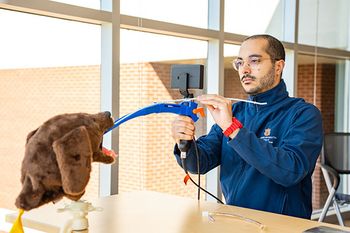
Tasha McNerney, BS, CVT, CVPP, VTS (Anesthesia), director of training and staff development at Mount Laurel Animal Hospital in New Jersey, and a founder of the Anesthesia Nerds organization, describes the differences between mechanical ventilators used in the intensive care unit (ICU) for long-term patient treatment and those used for administering anesthesia, in an interview with dvm360. This discussion was part of a conversation about the VMX workshop on mechanical ventilation being presented by McNerney, Tami Lind, BS, RVT, VTS (ECC), and Darci Palmer, LVT, VTS (Anesthesia & Analgesia), on Saturday, January 25, 2025, for an audience of veterinary professionals who are new to mechanical ventilators or who are considering a ventilator purchase in the future.
The following is a transcript of the video:
Tasha McNerney, BS, CVT, CVPP, VTS (Anesthesia): An ICU ventilator is made for long term ventilation. A lot of times, with an ICU ventilator, they are pulling in oxygen right from an oxygen source and they're blending it in with room air, which is heavy in things like nitrous. However, an anesthetic ventilator, most of the time in veterinary medicine, is going to run on 100% oxygen. So, we're not usually blending in medical air or any or room air with that oxygen. It's straight up 100% oxygen. Also, in a patient who is on a long term ventilator or an ICU ventilator, they usually have some kind of humidifying agent, because oxygen is very drying to the tissues in the respiratory tract. And then they also have some kind of like humidification in there as well, whereas the cold, dry oxygen that's coming through an anesthetic ventilator is not put through those same treatments. So, yes, a little bit different. You wouldn't really want to have a patient long term on an anesthetic ventilator.