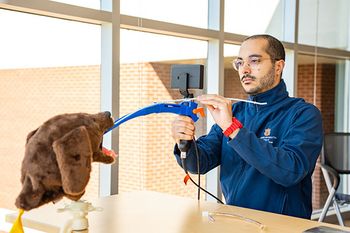
Veterinary and engineering students at Auburn University worked through several prototypes and campus visits to build a 3D-printed laryngoscope for teaching intubation in goats and pigs.
In tiny patients you might be concerned about extra dead space. Tasha McNerney, BS, CVT, CVPP, shares her favorite anesthesia tip she learned from Andrea M. Caniglia, VMD, DACVAA.
You can reduce your mechanical dead space by taking a 25 or 22 gauge Luer lock needle and attaching it directly to your CO2 sensor. Then place the needle into the endotracheal tube and you will get a nice reading on your capnography monitor. This way you avoid needing to use an elbow or other adaptor that would add to the mechanical dead space.