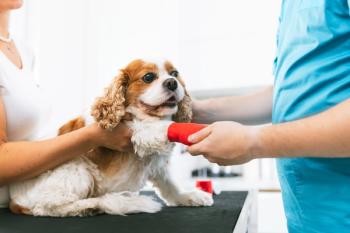
The Positive Preventive Veterinary Experience Protocol approach combines environmental changes, pain-reduction techniques, sensory distraction, and positive reinforcement to make preventive visits less stressful for pets and their owners.
Acute diarrhea is a daily reality in general practice—and a stressful one for pet owners.
Sponsored by Nestlé Purina.
Acute diarrhea is one of the most common reasons pets land in the exam room. In this interview with dvm360®, Becky Eschmann, DVM, MPH, CPH, DACVPM, breaks down what typically drives it, how to tell a self-limiting case from something more serious, and more.
Acute diarrhea is really, really common in general practice. If you look at the stats on initial canine sick visits, loose stool, vomiting, and diarrhea are the leading causes—so we live and breathe diarrhea. For the acute, self-limiting cases, the causes can vary a lot, from something mild to severe. We see things like dietary indiscretion: They ate something they weren't supposed to or got some human food that didn't settle so well, to pancreatitis and systemic illness.
Stress can play a really big role too, like stress colitis and stress-induced diarrhea, and we see that from a variety of causes, including disasters: the stress of the event, as well as the stress of potential displacement and being away from their normal routine.
There are also times of the year when we all, as practitioners and veterinary associates, anticipate more diarrhea and GI [gastrointestinal] cases—things around any holiday, get-togethers, Thanksgiving, Christmas, Fourth of July barbecues, where dogs are around a lot of different human food and people who might be more inclined to give them a treat or something that isn't really best suited for them and could potentially make them sick.
That’s going to depend on the clinical presentation of the patient. The first step is to evaluate the whole patient, because diarrhea by itself is a nonspecific clinical sign. I am more concerned when a pet is lethargic, has other clinical abnormalities, or when diagnostics reveal findings that suggest a more serious underlying disease process.
When discussing gut health, it is helpful to think about the microbiota and microbiome as a whole. I like to use the theater analogy: the microbiota are the actors, while the microbiome is the entire production, including the actors and crew, and all the interactions that keep it running smoothly. When dysbiosis occurs and the balance between beneficial and potentially pathogenic bacteria is disrupted, we often see diarrhea. Maintaining that balance helps support a healthy microbiome and may improve resilience during periods of GI stress. Studies evaluating Enterococcus lactis SF68 have demonstrated benefits for both microbiome and immune health. This research suggests that supporting a stable microbiome may help reduce the risk of diarrhea when stress happens
When it comes to probiotics, strain matters. It’s important to look for strains supported by scientific evidence. Because probiotics are regulated as supplements, the science behind the product matters as regulatory oversight is limited.
FortiFlora and FortiFlora Pro both contain Enterococcus lactis SF68, which has been evaluated in more than 25 unique studies in dogs and cats and has a long history of safety and efficacy. They also share the same highly palatable flavoring, which can be especially beneficial for pets experiencing GI upset. The key difference is that FortiFlora Pro contains psyllium, a prebiotic fiber. While both products provide the probiotic E. lactis SF68, FortiFlora Pro combines a probiotic and prebiotic, making it a synbiotic. FortiFlora Pro is available through veterinary-exclusive channels, whereas FortiFlora is available through pet specialty stores.
Both FortiFlora and FortiFlora Pro utilize microencapsulation technology to support product stability and protect E. lactis SF68 during passage through the GI tract. This helps ensure delivery of the guaranteed level of viable microorganisms to the intestinal tract. Once there, E. lactis SF68 has been shown to increase beneficial endogenous bacteria, such as bifidobacteria and lactobacilli. It can also help support immune health at both the local and systemic level, and we see those benefits in a variety of situations. For example, E. lactis SF68 may help reduce the incidence of conjunctivitis in cats with feline herpesvirus 1. E. lactis SF68 also supports stool quality and can help maintain normal stool consistency during stressful situations. The same microbiome supporting benefits are part of the Diarrhea Response Kit because E. lactis SF68 is included there as well.
Communication and setting clear expectations are essential for ensuring compliance and follow-through with any therapeutic plan. When discussing the Diarrhea Response Kit, I emphasize that it is a two-step approach designed to help manage pets with acute diarrhea. I walk pet owners through the different sachets, explaining what each contains and how to administer them.
The FortiFlora Response sachets contain kaolin, pectin, and the probiotic E. lactis SF68 and can be used for up to 72 hours, or 3 days. I explain that if the stool returns to normal before the 3 days are up, they can stop the Response sachets and transition to the FortiFlora or FortiFlora Pro included in the kit. If the diarrhea persists after 3 days, I’m more concerned that there may be an underlying issue, and I would recommend re-evaluating the patient.
In addition to explaining the steps, I also like to explain the rationale behind the product and how easy it is to use. The sachets are highly palatable and can simply be mixed with a small amount of food or their regular meal. The kaolin and pectin helps to initially improve stool consistency and increase fecal bulk during the initial episode of diarrhea, while E. lactis SF68 helps provide ongoing microbiome support after we get the initial diarrhea under control.